Ratios, rates, and proportions
How the SAT tests this, with worked examples — plus the 1 skills it covers. Free to read, no account needed.
A ratio compares two quantities, and a proportion sets two ratios equal. Nearly every question here is solved by writing a proportion and cross-multiplying.
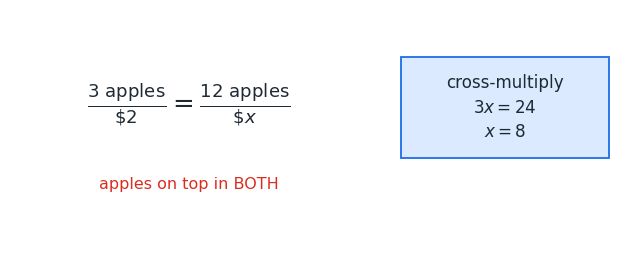
The one rule that prevents mistakes is consistency: whatever is on top in the first fraction must be on top in the second. Apples over price equals apples over price. Mixing the order is the commonest error and produces an answer that is offered.
A rate is a ratio with different units, such as kilometres per hour or dollars per kilogram. A unit rate has in the denominator, which makes comparisons easy — the better value is whichever has the lower cost per unit.
For a ratio shared between parts, such as splitting in the ratio , add the parts to get shares, divide to find one share, then multiply.
Watch for questions giving a ratio and a difference rather than a total, since they need the same share method applied to the difference instead.
Worked examples
If apples cost , what do apples cost?
Keep apples on top in both fractions
Keep apples on top in both fractions
Split in the ratio .
There are shares, so one share is , giving and .
There are shares, so one share is , giving and .
Which is better value: g for or g for ?
Compare unit rates: per gram against per gram. The g pack is cheaper per gram.
Compare unit rates: per gram against per gram. The g pack is cheaper per gram.
Is ratios, rates, and proportions costing you points?
Take the free 10-question diagnostic for a predicted SAT score and a breakdown of which domains are costing you points.