Systems of linear equations word problems
How the SAT tests this, with worked examples — plus the 1 skills it covers. Free to read, no account needed.
These give a situation with two unknowns and enough information for two equations. The modelling is the work; solving is routine once the equations are written.
Start by naming the unknowns explicitly — let be the number of children and the number of adults — because most errors come from losing track of what a letter stands for.
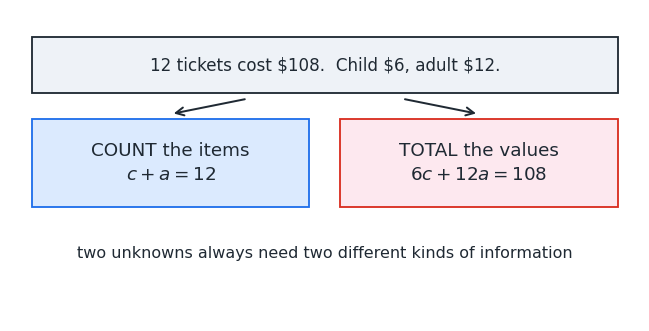
Then look for the two different kinds of information a question supplies. One equation usually counts items, the other totals values such as cost or weight.
So for tickets costing in total, with child tickets at and adult at , the count equation is and the value equation is .
Solve by substitution or elimination, whichever needs less rearranging, then answer the question asked. Having found both values, check whether the question wanted one of them, their difference, or something else entirely.
Worked examples
tickets cost . Child tickets are and adult tickets . How many were children?
Write a count equation and a value equation
Write a count equation and a value equation
Substituting gives , so and .
In the same problem, how many more children than adults were there?
With and , the difference is . The question asked for a difference, not a count — and will be among the choices for anyone who stopped early.
With and , the difference is . The question asked for a difference, not a count — and will be among the choices for anyone who stopped early.
Is systems of linear equations word problems costing you points?
Take the free 10-question diagnostic for a predicted SAT score and a breakdown of which domains are costing you points.