Text Structure and Purpose
How the SAT tests this, with worked examples — plus the 2 skills it covers. Free to read, no account needed.
These questions ask what a text does, not what it says. Summarising the content is not the same as naming its function, and the wrong answers live in that gap.
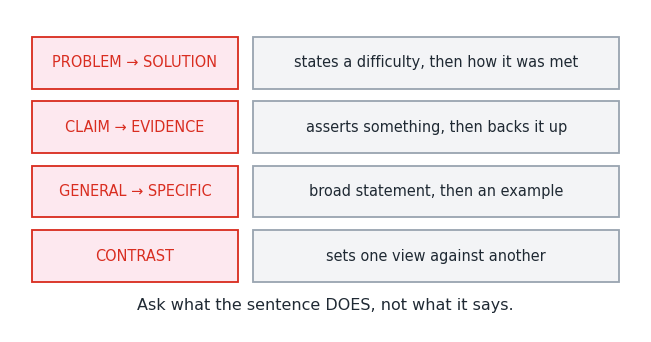
Two passages, two different structures.
Worked examples
In a recent interview, Karl Ove Knausgaard, author of the "My Struggle" series, spoke about his unconventional approach to literature. He emphasized the importance of delving into the seemingly mundane and ordinary aspects of life, believing that true connection and meaning emerge from exploring these everyday experiences. Knausgaard argues that literature shouldn't shy away from depicting the messy realities of life but should embrace them to create a sense of shared humanity.
Which choice best describes the overall structure of the text?
- AIt contrasts traditional approaches with an unconventional perspective, then evaluates the effectiveness of each.
- BIt discusses a writer's unconventional approach to literature and his views on connecting literature with everyday experiences.
- CIt presents a writer's view on challenges within literature, and discusses his approach to addressing that problem.
- DIt explores the historical context of literature during Knausgaard's time, then examines societal influences on his writing.
Track what the text actually does: it introduces an approach, then explains the belief behind it. That is all.
(B) is correct.
(A) requires a comparison and an evaluation. The text never describes traditional approaches, nor judges which works better.
(C) requires a problem. Knausgaard describes a preference, not a difficulty to be solved.
(D) requires historical context and societal influences, neither of which appears.
Each wrong answer names a structure that sounds like serious literary analysis. Test every element of the choice against the text — if any part is missing, the whole choice fails.
This text is taken from James Joyce's novel "Ulysses": Bloom wandered through the bustling Dublin streets, his mind a kaleidoscope of thoughts and memories. The sights, sounds, and smells of the city triggered a flood of associations — his argument with Blazes Boylan, the upcoming celebration, and a poignant memory of his deceased son, Rudy. These fragments intertwined with snippets of mythology, blurring the lines between reality and his own internal world. As he navigates the urban landscape, Bloom grapples with themes of loss, mortality, and the cyclical nature of life.
Which choice best describes the overall structure of the text?
- AIt introduces a character and then describes their daily commute.
- BIt presents a character's physical journey and then reveals its deeper psychological significance.
- CIt introduces a character and then details their specific plans for the celebration.
- DIt introduces a character on a walk and mentions his emotional state.
The text starts outside — streets, sights, sounds — and moves inward, to memory, then to loss and mortality. Outer journey, then inner meaning.
(B) is correct.
(A) describes the walk but ignores the entire second half.
(C) seizes on the celebration, which is one item in a list.
(D) is the tempting one: it is accurate, but mentions his emotional state badly understates a passage that ends on mortality and the cyclical nature of life. A choice can be true and still too weak to be the best description.
Is text structure and purpose costing you points?
Take the free 10-question diagnostic for a predicted SAT score and a breakdown of which domains are costing you points.