An SAT micro-topic explainer. Free to read — no account needed.
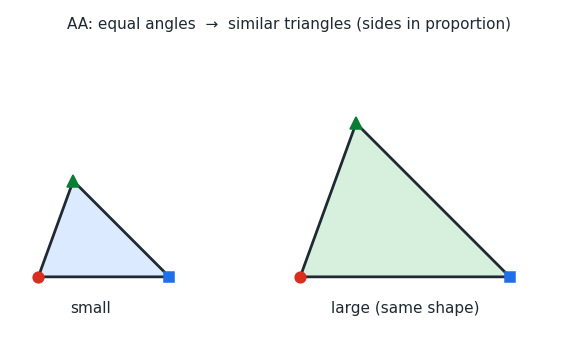
Two triangles are similar if they have exactly the same shape but not necessarily the same size. That means all three pairs of angles are equal and the sides are in the same ratio.
The quickest test is AA (Angle-Angle). If two angles of one triangle match two angles of the other, the triangles are similar. You only need two, because the third angle is then forced (all three add to 180∘).
Order matters when you name similar triangles. Writing △ABC∼△DEF means A matches D, B matches E, and C matches F. Then the matching sides line up: DEAB=EFBC=DFAC.
This proportion is how you find missing lengths. If one triangle is a scaled copy of another, set up the ratio of corresponding sides and solve. Corresponding sides are the ones opposite equal angles.
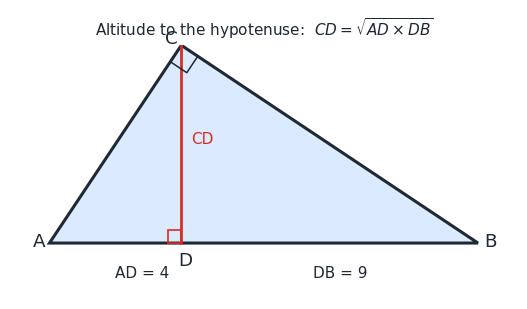
One classic case: in a right triangle, drop an altitude from the right angle to the hypotenuse. This creates two smaller triangles, each similar to the original and to each other. The altitude equals the square root of the two pieces it splits the hypotenuse into.
Worked examples
Triangle ABC has angles 50∘ and 60∘. Triangle DEF also has angles 50∘ and 60∘. Are they similar? Two pairs of angles are equal, which is the AA test. So yes, △ABC∼△DEF.
Given △ABC∼△DEF with AB=6, DE=3, and BC=8, find EF. Matching sides are in proportion: DEAB=EFBC. So 36=EF8, which gives EF=4.
In a right triangle, the altitude to the hypotenuse splits it into pieces of length 4 and 9. How long is the altitude? The altitude is the square root of the product of the two pieces. So it is 4×9=36=6.
Is this one of the topics costing you points?
Take the free 10-question diagnostic for a predicted SAT score and a breakdown of which domains are costing you points.