An SAT micro-topic explainer. Free to read — no account needed.
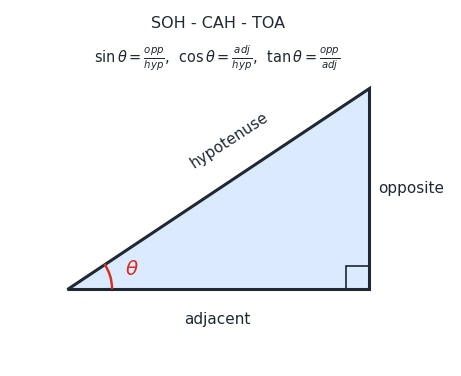
In a right triangle, each acute angle has three trig ratios based on the side lengths. Relative to the angle, one side is opposite, one is adjacent, and the longest (across from the right angle) is the hypotenuse.
The ratios are remembered as SOH-CAH-TOA. sin=hypotenuseopposite, cos=hypotenuseadjacent, and tan=adjacentopposite.
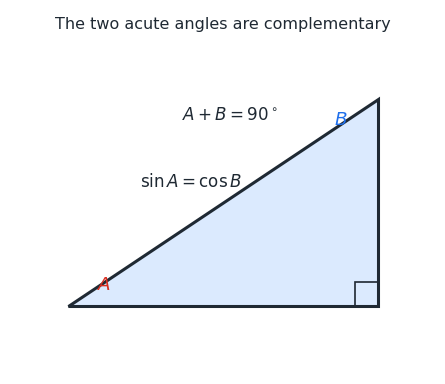
The two acute angles of a right triangle always add to 90∘; they are complementary. The side opposite one angle is adjacent to the other, so sin of one equals cos of the other: sinA=cosB.
Written with angles, this is the co-function identity: sin(A)=cos(90∘−A). So whenever you see sin(something)=cos(something else), the two angles inside must add to 90∘. Setting their sum equal to 90 lets you solve for the unknown.
The same idea works in radians, where 90∘=2π. So cos(2π−x)=sin(x), and for example sin(6π)=cos(3π) because 6π and 3π add to 2π.
Worked examples
If sin(A∘)=54, what is cos(90∘−A∘)? By the co-function rule, cos(90∘−A)=sin(A). So cos(90∘−A∘)=54.
If sin(3x−12∘)=cos(2y+7∘), how are x and y related? Since sin equals cos only when the angles are complementary, the two angles add to 90∘. So (3x−12)+(2y+7)=90, which simplifies to 3x+2y=95.
If cos(θ)=0.6, what is sin(90∘−θ)? By the co-function rule, sin(90∘−θ)=cos(θ). So sin(90∘−θ)=0.6.
Is this one of the topics costing you points?
Take the free 10-question diagnostic for a predicted SAT score and a breakdown of which domains are costing you points.