An SAT micro-topic explainer. Free to read — no account needed.
A two-way frequency table shows how data splits across two categories at the same time. One category runs down the rows and the other across the columns, and each inner cell counts the people or things that fall in both.
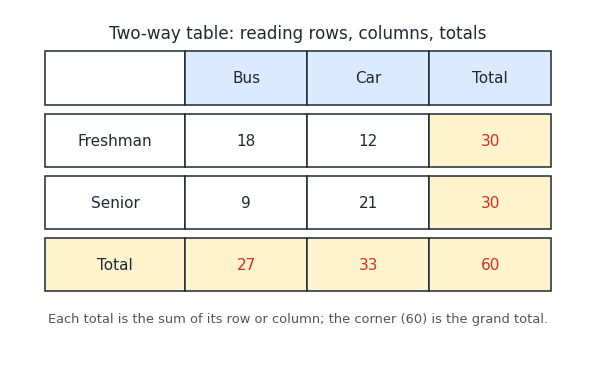
Reading a single cell answers "how many are in both groups." In a table of students by year and commute, the cell in the "Freshman" row and "Bus" column might read 18, meaning 18 students are freshmen who take the bus. Every inner cell works this way.
The totals summarize one category at a time. The total at the end of the "Freshman" row counts all freshmen regardless of commute, and the total at the foot of the "Bus" column counts all bus riders regardless of year. The bottom-right corner is the grand total of everyone.
Most questions are answered by picking the right cell or total and, if a fraction is asked, choosing the correct denominator. "What fraction of freshmen take the bus?" divides the freshman-bus cell by the freshman total, not by the grand total. Matching the denominator to the group the question asks about is the key step.
Worked examples
A table shows students by year and commute: 18 freshmen take the bus, 12 freshmen take a car, giving 30 freshmen in all. What fraction of freshmen take the bus? (A) 3018 (B) 6018 The question is about freshmen, so the denominator is the freshman total, 30, not the grand total. So (A), 3018=53, is correct.
In the same table, 27 students take the bus in total and there are 60 students overall. What fraction of all students take the bus? (A) 6027 (B) 3027 The question asks about all students, so the denominator is the grand total, 60. So (A), 6027, is correct.
A table splits 60 people into 27 bus riders and the rest car riders, with 30 freshmen and 30 seniors. If 21 seniors take a car, how many seniors take the bus? The senior row must total 30, and 21 of them take a car. So the seniors who take the bus are 30−21=9.
Is this one of the topics costing you points?
Take the free 10-question diagnostic for a predicted SAT score and a breakdown of which domains are costing you points.