An SAT micro-topic explainer. Free to read — no account needed.
A factor of a polynomial is one of the pieces that multiply together to build it. In (x+2)(x−1), both (x+2) and (x−1) are factors. A factor divides the polynomial evenly, leaving no remainder.
Here is the central idea, called the Factor Theorem. If (x−a) is a factor of f(x), then f(a)=0. The reason is simple: substituting x=a makes that factor (a−a)=0, and zero times anything is zero.
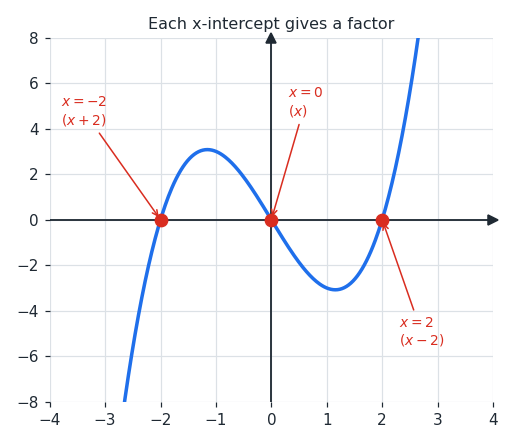
A value that makes f(x)=0 is called a zero (or root) of the polynomial. On a graph, a zero is exactly where the curve crosses the x-axis. So factors, zeros, and x-intercepts are three ways of describing the same thing.
This works in reverse too. If you know the zeros, you can write the factored form. A polynomial with zeros at x=−2 and x=4 has the form a(x+2)(x−4), where a is a constant.
A factor can repeat, like (x−2)2 in (x−1)(x−2)2. A repeated factor still gives the same zero, x=2, but the graph touches the x-axis there instead of crossing it.
Worked examples
If (x−3) is a factor of a polynomial f(x), what is f(3)? By the Factor Theorem, a factor (x−a) means f(a)=0. Here a=3, so f(3)=0.
A polynomial has zeros at x=1 and x=−2. Write a possible factored form. Each zero x=c gives a factor (x−c). So the factors are (x−1) and (x+2), giving f(x)=a(x−1)(x+2) for some constant a.
If (x−2) is a factor of x3+ax2+bx+6, what equation must a and b satisfy? By the Factor Theorem, f(2)=0. Substituting x=2: 23+a(2)2+b(2)+6=0, so 8+4a+2b+6=0, giving 4a+2b+14=0.
Is this one of the topics costing you points?
Take the free 10-question diagnostic for a predicted SAT score and a breakdown of which domains are costing you points.