Understanding when to substitute unknowns with numbers
An SAT micro-topic explainer. Free to read — no account needed.
Some questions can be solved much faster by choosing your own numbers for the unknowns instead of doing the algebra. The idea is to substitute an easy value, work out the answer, and then see which answer choice matches.
Here is the whole method in one example. Suppose a question asks which expression is equivalent to 2(x+3), with choices 2x+3, 2x+6, x+6, and 2x+5. Since everything is written in terms of x, pick a simple value like x=1. The expression becomes 2(1+3)=8. Now test the choices at x=1: they give 5, 8, 7, and 7. Only 2x+6 gives 8, so it is the answer.
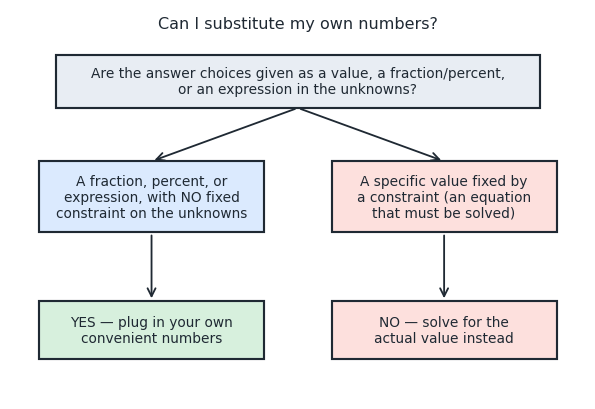
This works whenever two things are true. First, the answer is a relationship — a fraction, percent, ratio, or an expression in the variables — not one fixed number. For instance, if a question asks what fraction of a class passed and gives only fractions, the class size does not matter: 3018 and 106 are the same fraction, so you can just assume 30 students. Second, nothing fixes the unknowns to particular values. When both hold, any numbers you pick give the same answer, so choose easy ones.
It does not work when the question asks for a specific value that the information pins down. For example, "a number increased by 5 equals 12" forces the number to be exactly 7. Guessing n=3 gives 8, not 12, so a random value fails. Whenever a constraint (an equation you must solve) fixes the unknown, solve it instead of assuming.
For questions built entirely on percentages, 100 is the perfect number to assume. Say a price rises 20% and then falls 10%: start at $100, go up to $120, then down to $108. Reading the final answer off 100 is far easier than tracking the percentages in symbols.
Two tips make this reliable. Pick small, easy numbers, but avoid 0 and 1, because they often make several choices give the same result. And if two choices happen to match your first number, just try a second number to break the tie.
Worked examples
Which of the following is equivalent to 3(x−2)+4? (A) 3x−2 (B) 3x+2 (C) x+2 (D) 3x+6 Since the question and every choice are in terms of x, pick a simple value like x=2. The expression becomes 3(2−2)+4=4. Testing the choices at x=2: (A) gives 4, (B) gives 8, (C) gives 4, and (D) gives 12. Both (A) and (C) give 4, so try x=3: the expression is 3(1)+4=7, (A) gives 7, and (C) gives 5. Only (A) matches, so (A) is the answer.
A shirt's price is raised by 30% and then lowered by 10%. What percent of the original price is the final price? (A) 120% (B) 117% (C) 121% (D) 90% Since it is all percentages with no fixed price, assume the original is $100. A 30% rise gives $100→$130. A 10% drop gives $130→$130−$13=$117. So the final price is 117% of the original, which is (B).
Can you solve 2n+5=17 by assuming any value for n? No — this equation constrains n to one specific value, so you must solve it. Subtracting 5 from both sides gives 2n=12, so n=6. A guess like n=3 would give 2(3)+5=11, not 17, so only n=6 works.
Is this one of the topics costing you points?
Take the free 10-question diagnostic for a predicted SAT score and a breakdown of which domains are costing you points.