An SAT micro-topic explainer. Free to read — no account needed.
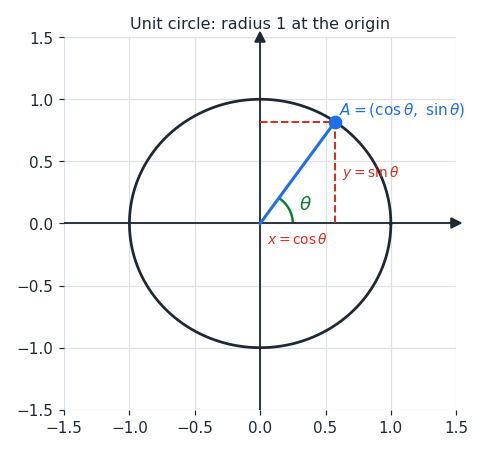
The unit circle is a circle of radius 1 centered at the origin. Draw an angle θ from the positive x-axis; where its ray meets the circle is a point A. That point's coordinates are exactly (cosθ,sinθ).
This gives a simple rule: the x-coordinate of the point is cosθ, and the y-coordinate is sinθ. So if you know where the point is, you can read off both values with no triangle needed. And tanθ=cosθsinθ=xy.
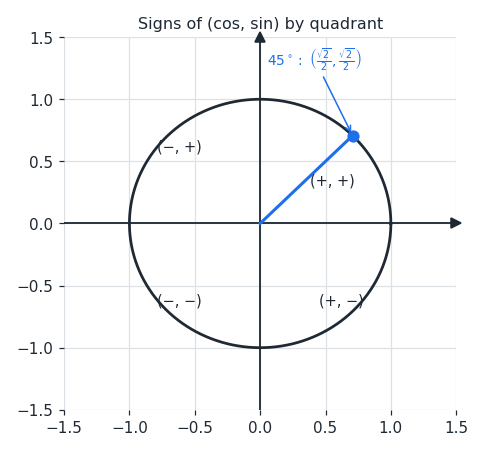
Because x and y change sign in different quadrants, so do cos and sin. In Quadrant II, x<0 and y>0, so cosθ is negative and sinθ is positive. If you know one coordinate, the other comes from x2+y2=1, choosing the sign that fits the quadrant.
A few key angles come up again and again. At 45∘, the point is (22,22). Angles are often measured in radians, where 6π=30∘, 4π=45∘, and 3π=60∘.
For angles past 90∘, use symmetry. The point for 67π sits in Quadrant III directly opposite the point for 6π, so both coordinates simply flip sign. This lets you find cos and sin of large angles from the familiar small ones.
Worked examples
A point on the unit circle at angle θ has coordinates (−21,23). What is cosθ? On the unit circle, cosθ is the x-coordinate of the point. So cosθ=−21.
An angle θ is in Quadrant II with sinθ=135. What is cosθ? Here sinθ=y=135, so use x2+y2=1: x2=1−16925=169144. So x=±1312, and since Quadrant II has x<0, cosθ=−1312.
The terminal side of an angle meets the unit circle at 45∘. What is cos(45∘)? At 45∘ the point is (22,22), and cos is the x-coordinate. So cos(45∘)=22.
Is this one of the topics costing you points?
Take the free 10-question diagnostic for a predicted SAT score and a breakdown of which domains are costing you points.