An SAT micro-topic explainer. Free to read — no account needed.
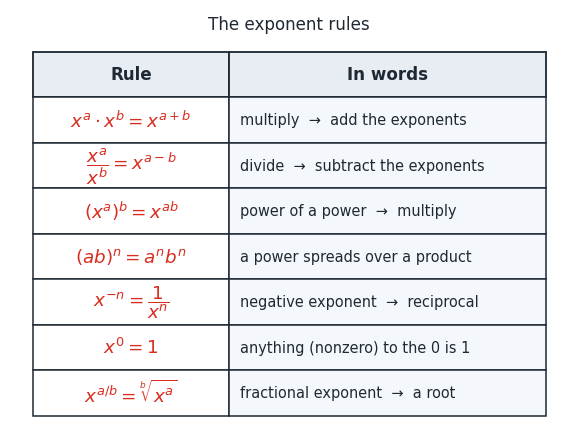
An exponent is a shorthand for repeated multiplication: x3=x⋅x⋅x. When you multiply powers of the same base, you add the exponents: xa⋅xb=xa+b. When you divide them, you subtract: xbxa=xa−b.
Two more rules handle powers of powers and products. A power of a power multiplies the exponents: (xa)b=xab. And a power spreads over everything in a product: (ab)n=anbn, so (2x)3=23x3=8x3.
A negative exponent means take the reciprocal: x−n=xn1. This also works in reverse, so x−n1=xn — a negative exponent in the denominator moves up top and becomes positive.
Two special cases round things out. Any nonzero base to the power 0 is 1, so x0=1. A fractional exponent is a root: xa/b=bxa. For example, 274/3=(33)4/3=34=81.
Hard-looking expressions come apart one rule at a time. Take (3x)−2(2x)3. First spread the powers: (2x)3=8x3, and the negative exponent flips up to give (3x)2=9x2. Then multiply and add exponents: 8x3⋅9x2=72x5.
Worked examples
Simplify (4y)2. A power spreads over a product: (4y)2=42⋅y2. So (4y)2=16y2.
Simplify 274/3. Write 27 as 33, then use the power-of-a-power rule: (33)4/3=33×34=34. So 274/3=81.
Simplify (5a−3)−2. Spread the outer power: (5a−3)−2=5−2⋅(a−3)−2. The power of a power multiplies exponents, so (a−3)−2=a6, and 5−2=251. So the result is 25a6.
Is this one of the topics costing you points?
Take the free 10-question diagnostic for a predicted SAT score and a breakdown of which domains are costing you points.