An SAT micro-topic explainer. Free to read — no account needed.
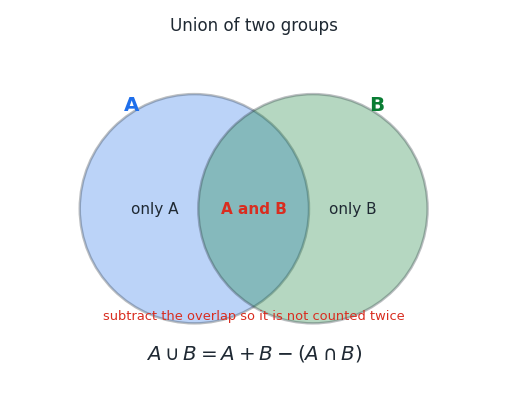
A Venn diagram shows two groups as overlapping circles. Where the circles overlap sits the group of items that belong to both, and where they do not overlap sit the items in only one group. Anything outside both circles belongs to neither.
The key formula is for the number in at least one group, written A∪B ("A union B"). You add the two groups, but the overlap got counted in both, so you subtract it once: A∪B=A+B−(A∩B), where A∩B ("A intersection B") is the overlap. For example, if 25 people study French, 27 study Spanish, and 15 study both, then 25+27−15=37 study at least one.
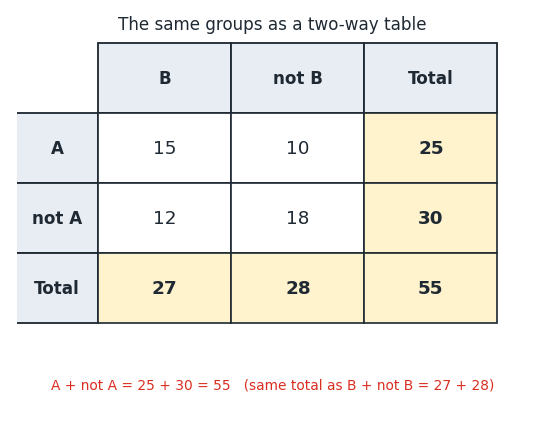
The very same groups can be organized as a 2×2 table. The rows are "A" and "not A", the columns are "B" and "not B", and each of the four inner cells counts the people in that combination. A "Total" row and column are added around the edge.
The table's power is that the totals must agree. Reading across, the "A" row and the "not A" row add up to the whole group: A+not A=total. Reading down, the "B" column and the "not B" column add up to the same total: B+not B=total. So if a cell is missing, you can fill it in by making a row or column reach its total.
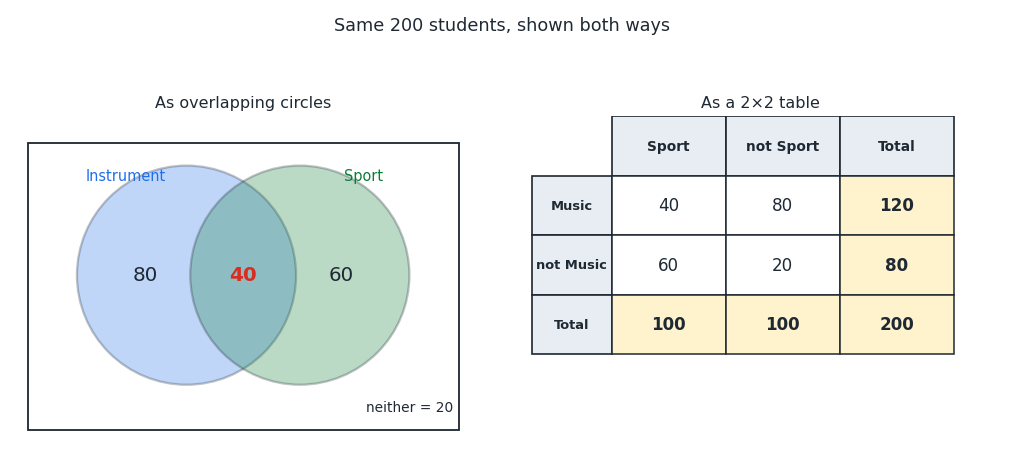
Here is a full question shown both ways. In a class of 200 students, 120 play an instrument, 100 play a sport, and 40 play both. As overlapping circles, 120−40=80 play only an instrument, 40 play both, 100−40=60 play only a sport, and the other 200−180=20 play neither. As a 2×2 table, those same four numbers fill the grid, and the instrument row adds to 120, the sport column adds to 100, and everything adds to 200.
Worked examples
Out of 90 people who own a bike, 25 also own a scooter. How many own only a bike? The overlap "both" is 25, and the rest of the bike group owns only a bike. So 90−25=65 own only a bike.
In a class, 18 students study French and 15 study Spanish, and 6 study both. How many study at least one of the two languages? Use A∪B=A+B−(A∩B): add the two groups and subtract the overlap, 18+15−6. So 27 students study at least one language.
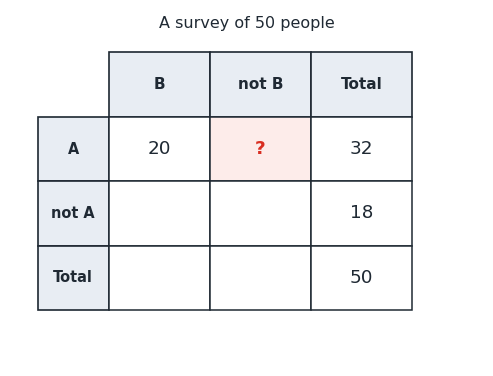
A survey of 50 people is shown in the table below. What is the missing "not B" value in the "A" row? (A) 12 (B) 22 The two cells in the "A" row must add up to the row total of 32. Since the "B" cell is 20, the "not B" cell is 32−20=12. So (A) is correct.
Is this one of the topics costing you points?
Take the free 10-question diagnostic for a predicted SAT score and a breakdown of which domains are costing you points.