An SAT micro-topic explainer. Free to read — no account needed.
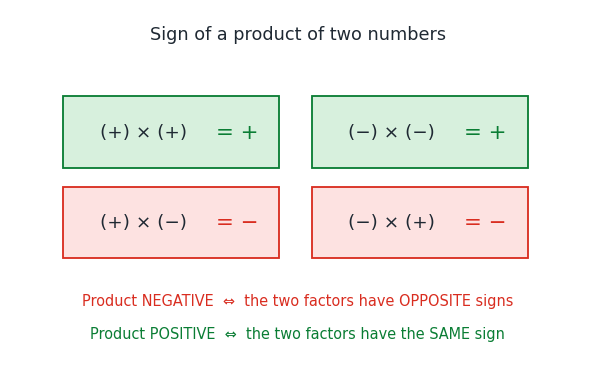
The sign of a product of two factors depends only on the signs of those factors: same signs give a positive product, opposite signs give a negative product.
So "the product is negative" means the two factors have opposite signs, and you check both cases one at a time. For (x+1)(x−4)<0, either x+1>0 and x−4<0, giving x>−1 and x<4, so −1<x<4; or x+1<0 and x−4>0, giving x<−1 and x>4, which is impossible. So the product is negative for −1<x<4.
Likewise, "the product is positive" means the two factors share a sign, and again you check both cases. For (x+2)(x−3)>0, either both are positive, x>−2 and x>3, giving x>3; or both are negative, x<−2 and x<3, giving x<−2. So the product is positive for x<−2 or x>3.
So the recipe is always the same: decide whether you need opposite signs (for a negative product) or the same sign (for a positive product), then work through each case and combine the results. Take it one factor at a time and keep track of which values of x satisfy both conditions in a case. There is no shortcut — the sign rule plus careful case-checking is the whole method.
Worked examples
For which values of x is (x−2)(x+3)<0? A product is negative only when the two factors have opposite signs, so check both cases. Case 1: x−2>0 and x+3<0 means x>2 and x<−3, which is impossible. Case 2: x−2<0 and x+3>0 means x<2 and x>−3, so −3<x<2, and that is the answer.
For which values of x is (x−1)(x−5)>0? A product is positive only when the two factors have the same sign, so check both cases. Case 1: both positive, x−1>0 and x−5>0, means x>1 and x>5, so x>5. Case 2: both negative, x−1<0 and x−5<0, means x<1 and x<5, so x<1; combining, the answer is x<1 or x>5.
If mn<0 and m>0, what is the sign of n? Since mn<0, the product is negative, so m and n must have opposite signs. We are told m is positive, so n must be the opposite: negative. Therefore n<0.
Is this one of the topics costing you points?
Take the free 10-question diagnostic for a predicted SAT score and a breakdown of which domains are costing you points.