Circle equations
An SAT Math micro-topic under Circle equations (Geometry and trigonometry). Free to read — no account needed.
Every circle in the plane can be written as , where is the centre and is the radius. The centre coordinates are subtracted inside the brackets, and the number on the right is the radius squared.
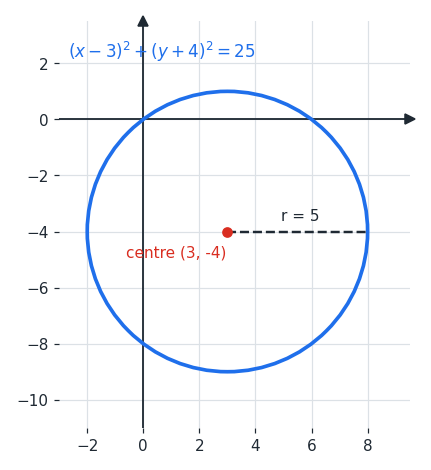
Read the graph above. The equation matches the form with and , because is really . And the right side is , so , not . Watch those two things: the sign inside the brackets, and the square root of the right side.
To go the other way and build the equation, put the centre and radius into the form.
For centre and radius : , which is .
For centre and radius : , which is .
Worked examples
Find the centre and radius of .
Compare with : , , and so .
Centre , radius .
Compare with : , , and so .
Centre , radius .
Find the centre and radius of .
Rewrite as , so and .
And gives .
Centre , radius .
Rewrite as , so and .
And gives .
Centre , radius .
Write the equation of the circle with centre and radius .
Substitute into :
.
Substitute into :
.
Is this one of the topics costing you points?
Take the free 10-question diagnostic for a predicted SAT score and a breakdown of which domains are costing you points.