Distance between 2 points
An SAT Math micro-topic under Circle equations (Geometry and trigonometry). Free to read — no account needed.
The distance between two points and is . This is just the Pythagorean theorem: the two points are opposite ends of the slanted side of a right triangle.
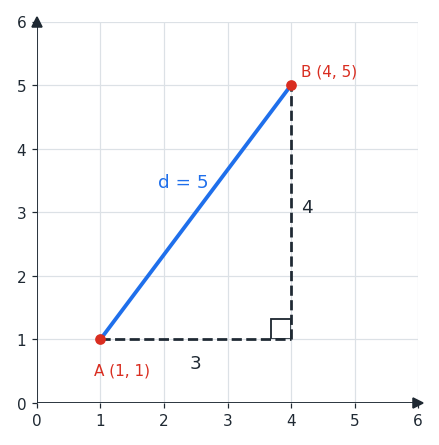
In the figure the horizontal gap between and is and the vertical gap is . These are the two legs, so the distance is the hypotenuse: .
The order of the points does not matter. For and , the horizontal gap is and the vertical gap is , giving . Squaring removes the sign, so you get the same answer whichever point you start from.
Worked examples
Find the distance between and .
Horizontal gap , vertical gap .
Distance .
Horizontal gap , vertical gap .
Distance .
Find the distance between and .
Horizontal gap , vertical gap .
Distance .
Horizontal gap , vertical gap .
Distance .
A circle has a diameter with endpoints and . How long is the diameter?
Horizontal gap , vertical gap .
Length .
Horizontal gap , vertical gap .
Length .
Is this one of the topics costing you points?
Take the free 10-question diagnostic for a predicted SAT score and a breakdown of which domains are costing you points.