Discriminant of a quadratic equation
An SAT Math micro-topic under Solving quadratic equations (Advanced Math). Free to read — no account needed.
The discriminant of a quadratic is the quantity . It comes from under the square root in the quadratic formula, so its sign decides how many real solutions exist.
There are three cases: gives two real solutions, gives exactly one, and gives no real solutions.
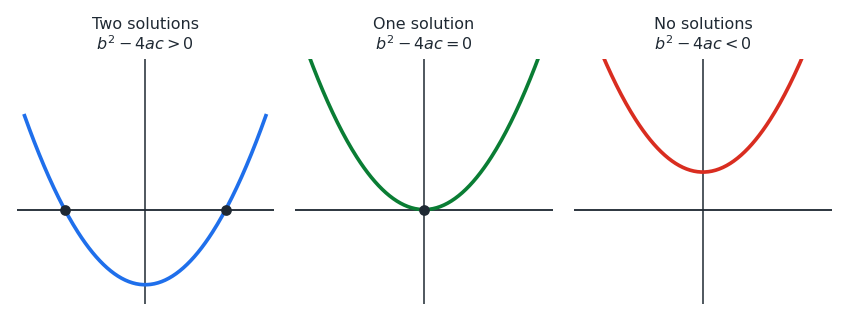
The graph shows why. A parabola with two real solutions crosses the -axis at two points, one with a single solution just touches the axis at one point, and one with no real solutions never reaches the axis.
To use it, first identify , , and , then plug in. For , , , , so and there are two solutions.
Many questions run this backwards: they give a condition and ask for a constant. To make have exactly one solution, set the discriminant to zero: , so .
Worked examples
How many real solutions does have?
Here , , .
Discriminant . Since it is positive, there are two solutions.
Here , , .
Discriminant . Since it is positive, there are two solutions.
For what value of does have exactly one solution?
Set the discriminant to zero: .
So , giving .
Set the discriminant to zero: .
So , giving .
Show that has no real solutions.
Here , , .
Discriminant . Since it is negative, there are no real solutions.
Here , , .
Discriminant . Since it is negative, there are no real solutions.
Is this one of the topics costing you points?
Take the free 10-question diagnostic for a predicted SAT score and a breakdown of which domains are costing you points.