An SAT Math micro-topic under Solving quadratic equations (Advanced Math). Free to read — no account needed.
The solutions of a quadratic equation are the values of x that make it true. They are also called the roots of the equation. For example, x=2 is a solution of x2−4=0 because 22−4=0.
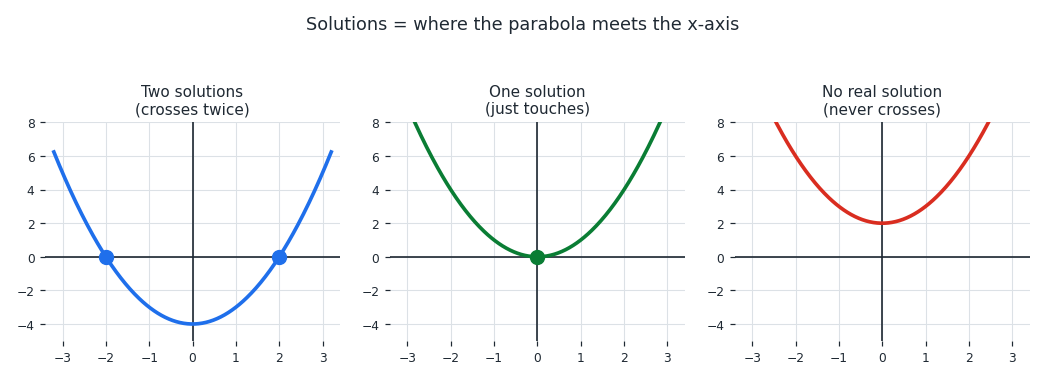
A quadratic equation has at most 2 solutions. Think of the graph, which is a parabola. The solutions are wherever the parabola meets the x-axis. If it crosses twice, there are two solutions. If it just touches the axis, there is one solution. If it never reaches the axis, there is no real solution.
If you know the two roots, you can build the equation. When the roots are k and m, the equation is (x−k)(x−m)=0. Say the roots are 3 and −5. Then the equation is (x−3)(x+5)=0, which multiplies out to x2+2x−15=0.
Roots with square roots come in matching pairs. If 2−3 is a root, then 2+3 is the other root. These are called conjugates: the same numbers, with the opposite sign in the middle.
Sometimes the two solutions are equal. For example, x2−6x+9=0 factors as (x−3)2=0, so x=3 twice. We say the equation has one unique solution. On the graph, the parabola just touches the x-axis at that point instead of crossing it.
Worked examples
One root of a quadratic equation is 1+2. What is the other root? Roots with square roots come in conjugate pairs. So the other root is 1−2.
The two solutions of a quadratic equation are x=4 and x=4. What does this tell us? The two solutions are equal, so there is really only one unique solution. On a graph, the parabola touches the x-axis at x=4 instead of crossing it.
A quadratic equation has roots −2 and 6. What is the equation? With roots k and m, the equation is (x−k)(x−m)=0. So it is (x+2)(x−6)=0. Multiplying out gives x2−4x−12=0.
Is this one of the topics costing you points?
Take the free 10-question diagnostic for a predicted SAT score and a breakdown of which domains are costing you points.