An SAT Reading & Writing micro-topic under Form, Structure and Sense (Expression of Ideas + Standard English Conventions). Free to read — no account needed.
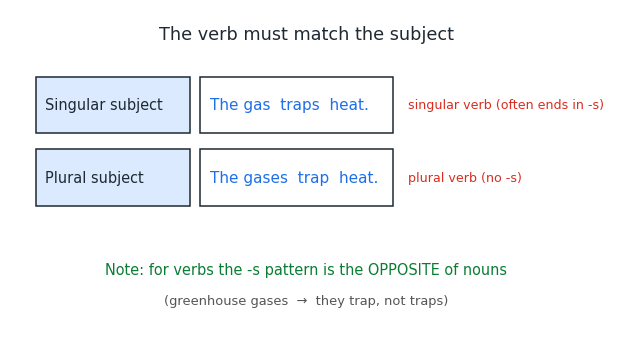
Subject-verb agreement is the rule that a verb must match its subject in number. If the subject is singular, the verb is singular; if the subject is plural, the verb is plural.
The tricky part is that the −s works backwards compared with nouns. A singular present-tense verb usually ends in −s, as in "the gas traps heat", while the plural drops it, as in "the gases trap heat". So the −s you add to make a noun plural is the −s you remove to make a verb plural.
The main challenge is finding the true subject, which is often separated from the verb. In "a group of compounds known as greenhouse gases that ______ the sun's heat", the verb goes with "gases", which is plural, so the verb is "trap". Ignore the words in between and match the verb to the noun it truly belongs to.
So identify the subject, decide if it is singular or plural, then pick the matching verb. A single thing takes the −s form; two or more take the plain form. Watch for phrases that come between the subject and verb, because they are there to distract you.
Worked examples
Which verb fits? "Greenhouse gases ______ the sun's heat in the atmosphere." (A) traps (B) trap The subject "gases" is plural, so it needs the plural verb, which has no −s. So (B), "trap", is correct.
Which verb fits? "The scientist who studies these gases ______ them daily." (A) measures (B) measure The true subject is "scientist", singular, not the nearby "gases". A singular verb takes the −s form, so (A), "measures", is correct.
Which verb fits? "The list of ingredients ______ printed on the label." (A) is (B) are The subject is "list", which is singular, even though "ingredients" sits next to the verb. So the singular verb (A), "is", is correct.
Is this one of the topics costing you points?
Take the free 10-question diagnostic for a predicted SAT score and a breakdown of which domains are costing you points.