Form, Structure and Sense
How the SAT tests this, with worked examples — plus the 4 skills it covers. Free to read, no account needed.
This area covers the mechanics of a sentence: verbs agreeing with subjects, pronouns matching what they stand for, and modifiers sitting next to what they describe.
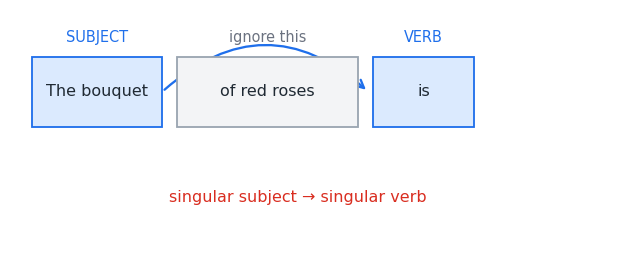
The two questions below show two different strands of it.
Worked examples
Besides offering such physiological rewards as toned muscles, _______ and produce numerous other benefits.
Which choice completes the text so that it conforms to the conventions of Standard English?
- Akarate, if practiced regularly, can turn the body into a dangerous weapon
- Bone can turn the body into a dangerous weapon through karate, if it is practiced regularly
- Cthe body can be turned into a dangerous weapon as a result of karate if practiced regularly
- Dwhen karate is practiced regularly, the body can be turned into a dangerous weapon
The sentence opens with a descriptive phrase: "Besides offering such physiological rewards as toned muscles". Whatever does the offering must be named straight after the comma. Karate offers the rewards.
(A) is correct — karate follows the comma.
(B) puts one there, saying a person offers toned muscles.
(C) and (D) both put the body there, saying the body offers the rewards rather than receiving them.
All four choices are grammatical English in isolation. Only the opening phrase decides which is right.
Given that Rembrandt painted his variations on Lastman's prototypes after he had returned to Leiden as an independent young master, one can speculate that Rembrandt may have been trying to emulate his former teacher by choosing the ________ but completely "rephrasing" them.
Which choice completes the text so that it conforms to the conventions of Standard English?
- Alatter subjects
- Blatters' subjects
- Clatter's subjects
- Dlatter's subject
The sentence means the subjects belonging to the latter person — Lastman. So we need a possessive, and the later word them tells us the subjects are plural.
(C) is correct: latter's shows possession by one person, and subjects is plural to match them.
(A) has no possessive at all.
(B) is not a word; latter refers to one of two things and has no plural form.
(D) is possessive but singular, which clashes with them later in the sentence.
Note how different these two questions are: the first turned on modifier placement, the second on possessives and number. Both were decided by a single word elsewhere in the sentence.
Is form, structure and sense costing you points?
Take the free 10-question diagnostic for a predicted SAT score and a breakdown of which domains are costing you points.