An SAT Math micro-topic under Radical, rational, and absolute value equations (Advanced Math). Free to read — no account needed.
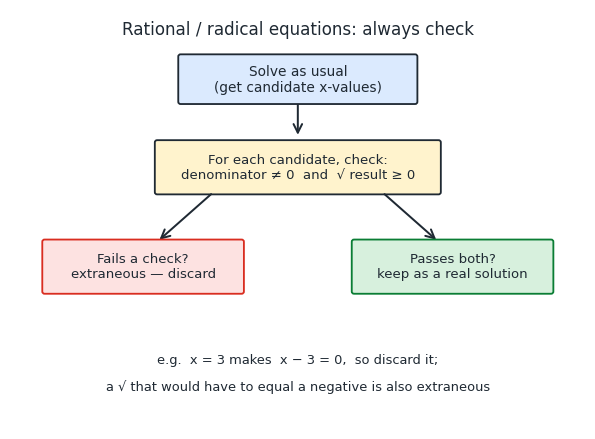
Equations with a variable in a denominator or under a root often give more candidate solutions than are actually valid. The extra ones are called extraneous, and the final step is always to check each candidate in the original equation.
A candidate is invalid if it makes any denominator zero. Solving x−32x2−18=12 leads to x=3, but x=3 makes x−3=0, so the original expression is undefined there. That value is extraneous, and here it leaves the equation with no valid solution.
A candidate is also invalid if it makes a square root equal a negative number. For 3x+1=x−3, squaring gives candidates x=1 and x=8. At x=1 the right side is −2, but a square root cannot be negative, so x=1 is extraneous; only x=8 works, since 25=5=8−3.
So solve the equation as usual, but treat the answers as candidates, not final. Substitute each one back into the original, and discard any that break a denominator or a root. Keeping only the survivors gives the true solution set, which may be one value, several, or none.
Worked examples
Solve x−5x2−25=10. Simplifying, x−5(x−5)(x+5)=x+5=10, so x=5, but x=5 makes the denominator x−5=0. That solution is extraneous, so the equation has no valid solution.
Solve 2x+3=x. Squaring gives 2x+3=x2, so x2−2x−3=0 with candidates x=3 and x=−1; test each. At x=−1 the root would equal −1, which is impossible, so it is extraneous; x=3 gives 9=3, so the only solution is x=3.
The equation x+11=x−1 gives candidates x=5 and x=−2. Which is valid? At x=−2 the right side is −3, but 9=3, so x=−2 is extraneous. At x=5, 16=4=5−1, so the valid solution is x=5.
Is this one of the topics costing you points?
Take the free 10-question diagnostic for a predicted SAT score and a breakdown of which domains are costing you points.