An SAT Math micro-topic under Radical, rational, and absolute value equations (Advanced Math). Free to read — no account needed.
When a variable sits under a root, the plan is to isolate the radical and then undo it. You undo a square root by squaring both sides, and a cube root by cubing both sides.
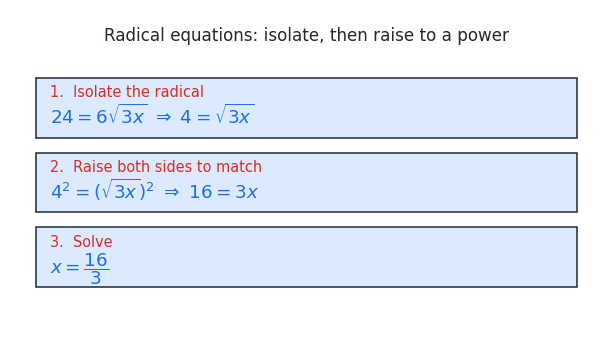
First get the radical alone. From 24=63x, divide both sides by 6 to get 4=3x. The root must be by itself before you raise to a power, or the other terms get in the way.
Then raise both sides to the power that cancels the root. Squaring 4=3x gives 16=3x, so x=316. A cube root needs cubing: 3x2y=x becomes x2y=x3, giving y=x5.
Because squaring can create false solutions, check each answer in the original. Substitute it back and confirm both sides match and that no root is being asked to equal a negative number. Keep only the values that truly satisfy the original equation.
Worked examples
Solve 2x−3=5. First isolate the radical: add 3 to both sides to get 2x=8, then divide by 2 to get x=4. Now square both sides: x=16, and checking, 216−3=8−3=5, so it is valid.
Solve 4x+1−x+4=0, which has a radical on each side. Isolate the radicals by moving one to the other side: 4x+1=x+4. Squaring both sides gives 4x+1=x+4, so 3x=3 and x=1; checking, 5−5=0, so it is valid.
Solve 3x−1+4=6. First isolate the radical: subtract 4 from both sides to get 3x−1=2. Now cube both sides: x−1=8, so x=9, and checking, 38+4=2+4=6.
Is this one of the topics costing you points?
Take the free 10-question diagnostic for a predicted SAT score and a breakdown of which domains are costing you points.