An SAT Reading & Writing micro-topic under Transitions (Expression of Ideas + Standard English Conventions). Free to read — no account needed.
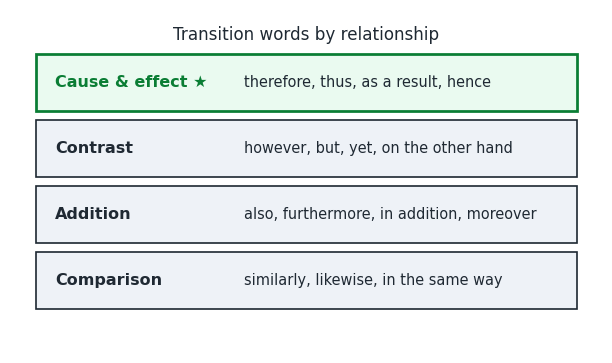
Transition words tell you how two parts of a text relate. A cause-and-effect transition means the second part happens because of the first — it is the result or consequence. The key words are therefore, thus, as a result, hence, and consequently.
Here is one in action. "The printing press made books cheap and fast to produce. As a result, ideas spread to far more people than before." The cheap books are the cause, and the spread of ideas is the effect, so "As a result" fits.
Be careful not to confuse cause-effect with other relationships. "However" signals a contrast, "also" or "furthermore" signals an addition, and "similarly" signals a comparison. These are wrong whenever the second part is actually a result of the first.
So before choosing a cause-effect word, check that the link really is cause and effect. Ask: does the second part happen because of the first? If not — if the parts just contrast or sit side by side — pick the transition that matches their true relationship instead.
Worked examples
Which transition best completes the text? "The new vaccine was distributed to every village in the region. ______, cases of the disease dropped sharply within months." (A) As a result (B) However The drop in cases happens because of the vaccine, so this is cause and effect. Choice (A), "As a result", fits; "However" would signal a contrast that is not there.
Which transition best completes the text? "New railroads let goods travel across the country in just days. ______, trade between distant cities grew rapidly." (A) Thus (B) Similarly The growth in trade is a direct consequence of faster shipping, so a cause-effect word is needed. Choice (A), "Thus", fits; "Similarly" would wrongly suggest the two parts are just alike.
Which transition best completes the text? "The Enlightenment prized reason and scientific analysis. ______, the Romantic movement that followed celebrated emotion and nature." (A) As a result (B) In contrast The second part does not happen because of the first; it describes an opposing set of values. So a cause-effect word is wrong, and (B), "In contrast", correctly signals the opposition.
Is this one of the topics costing you points?
Take the free 10-question diagnostic for a predicted SAT score and a breakdown of which domains are costing you points.