Transitions
How the SAT tests this, with worked examples — plus the 5 skills it covers. Free to read, no account needed.
A transitions question hides the connecting word and asks which one belongs. The trap is choosing by sound; the reliable move is to work out the relationship between the two sentences first, with the choices covered.
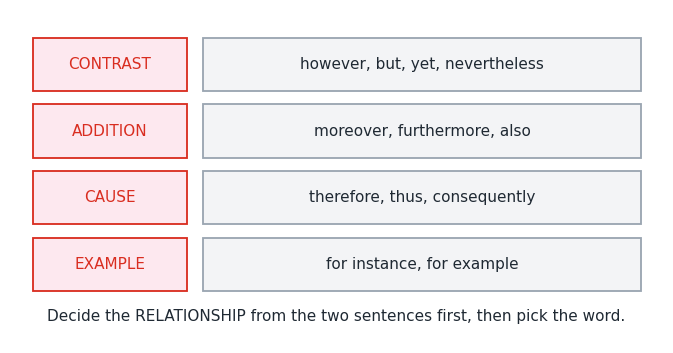
Here is what that looks like on two real questions.
Worked examples
Interest in deploying AI in a clinical setting has soared with evidence of its contribution to diagnostics, such as flagging early-stage breast cancers that may be missed by doctors. _________ researchers are grappling with how to manage serious risks in AI, given the damage that false diagnoses can cause to patients.
Which choice completes the text with the most logical transition?
- ASpecifically,
- BTherefore,
- CThat said,
- DIn addition,
First sentence: AI is promising. Second sentence: but it carries serious risks. The second pushes against the first, so the relationship is contrast. Plain-word test: but fits; so does not.
(C) is correct — that said is a contrast signal.
(B) claims the risks are a result of the promise, which reverses the logic.
(A) would introduce a detailed example of the previous point, but risks are not an example of benefits.
(D) signals more of the same, yet the second sentence changes direction rather than continuing.
In order to improve the stocks of Arapaima, a huge Amazonian fish, local communities working with Brazil's Mamirauá Sustainable Development Institute developed a model in 1999 that established protected lakes where fishing and hunting were prohibited. __________ local fishermen were allowed to harvest sustainable fish quotas that brought the arapaima back from near collapse.
Which choice completes the text with the most logical transition?
- ATherefore,
- BIn addition,
- CIn turn,
- DFor instance,
Both sentences describe parts of the same conservation model: protected lakes, and separately, sustainable quotas. The second adds another component rather than contrasting or concluding. The relationship is addition.
(B) is correct.
(A) and (C) both claim the quotas followed as a consequence of the protected lakes. They are parallel measures, not cause and effect.
(D) would make the quotas an example of the protected lakes, but they are a different measure entirely.
Compare this with the previous question: there the second sentence pushed against the first, here it adds to it. Naming that relationship before looking at the choices is the whole method.
Is transitions costing you points?
Take the free 10-question diagnostic for a predicted SAT score and a breakdown of which domains are costing you points.