An SAT Reading & Writing micro-topic under Rhetorical Synthesis (Expression of Ideas + Standard English Conventions). Free to read — no account needed.
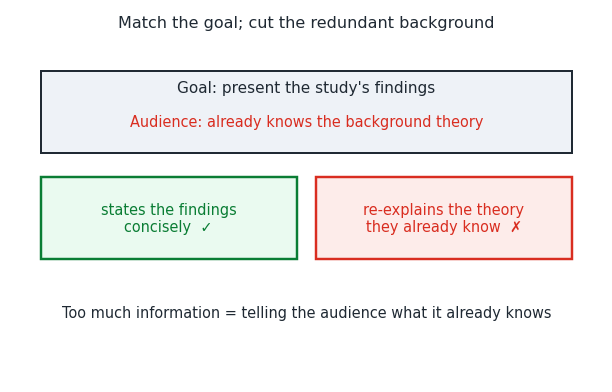
A rhetorical synthesis question gives you a student's research notes plus a specific goal and audience. A common wrong choice packs in too much information: it re-explains background the audience already has, or adds notes that do not serve the goal.
A student has taken these notes: • Einstein's theory of relativity has two parts: special and general relativity. • General relativity predicts that gravity bends the path of light. • In 2023, astrophysicists measured light from a distant star as it passed near the Sun. • The light bent by exactly the amount general relativity predicts. • It was the most precise test of the effect so far. The student wants to present the study's findings to an audience already familiar with relativity. Choice A: In 2023, astrophysicists measured a distant star's light bending near the Sun by exactly the predicted amount, the most precise confirmation of the effect yet. Choice B: Relativity, developed by Einstein, has two parts and predicts that gravity bends light, and in 2023 astrophysicists then measured this bending. Choice A goes straight to the new findings, which is the goal, while Choice B first re-explains relativity — background this audience already knows — so it includes too much information.
Here is another. A student has taken these notes: • Many birds migrate thousands of miles each year. • Scientists have long wondered how they navigate so accurately. • A 2024 study examined one songbird's sense of direction. • Researchers found tiny magnetic particles in the bird's beak. • These particles let the bird sense Earth's magnetic field to steer. The student wants to present the study's discovery to an audience already familiar with animal migration. Choice A: A 2024 study found that a songbird carries tiny magnetic particles in its beak, letting it sense Earth's magnetic field to navigate. Choice B: Animals migrate long distances each year and scientists have wondered how they navigate, and a 2024 study looked at one songbird's sense of direction. Choice A delivers the discovery directly, while Choice B fills its space with general background the audience already has, so it gives too much information.
So keep only what advances the goal for that specific audience, and cut the background they already know.
Worked examples
While researching, a student has taken the following notes: • Quantum entanglement links two particles so that one's state affects the other. • The effect works even when the particles are far apart. • A recent experiment measured a pair of entangled particles. • It detected instantaneous correlations between them. • The result hints at a new way information might be shared. The student wants to present the experiment's findings to an audience already familiar with quantum entanglement. Which choice most effectively presents the findings without including too much information? (A) A recent experiment detected instantaneous correlations between entangled particles, hinting at a new way information might be shared. (B) Quantum entanglement links two particles so one's state affects the other even far apart, and a recent experiment measured such a pair. Choice (A) reports the actual findings, which is the goal. Choice (B) stops to define entanglement, which this audience already knows, so it adds too much information.
While researching, a student has taken the following notes: • Cleopatra was the last active ruler of Ptolemaic Egypt. • She was famous for her alliances with powerful Roman leaders. • A newly translated papyrus dates to her reign. • The papyrus records a royal decree granting a tax exemption. • It bears a handwritten note that may be Cleopatra's own. The student wants to present what the papyrus reveals to an audience already familiar with Cleopatra's life. Which choice most effectively presents the new information without including too much information? (A) A newly translated papyrus from Cleopatra's reign records a tax-exemption decree and bears a note that may be in her own handwriting. (B) Cleopatra, the last ruler of Ptolemaic Egypt, was famous for her Roman alliances, and a newly translated papyrus from her reign has surfaced. Choice (A) gives the fresh detail from the papyrus, which is the goal. Choice (B) recaps Cleopatra's well-known life, which this audience already knows, so it includes too much information.
While researching, a student has taken the following notes: • Photosynthesis is how plants turn sunlight into usable energy. • It takes place mainly in a plant's leaves. • A 2024 study examined a rare fern that grows in deep shade. • The fern was found to photosynthesize in extremely low light. • It uses a pigment that captures wavelengths other plants cannot. The student wants to present the study's finding to an audience already familiar with photosynthesis. Which choice most effectively presents the finding without including too much information? (A) A 2024 study found a rare fern that photosynthesizes in extremely low light using a pigment that captures wavelengths other plants cannot. (B) Photosynthesis, which happens mainly in the leaves, is how plants turn sunlight into energy, and a 2024 study looked at a rare shade fern. Choice (A) states the new finding directly, which is the goal. Choice (B) explains what photosynthesis is, which this audience already knows, so it is too much information.
Is this one of the topics costing you points?
Take the free 10-question diagnostic for a predicted SAT score and a breakdown of which domains are costing you points.