Rhetorical Synthesis
How the SAT tests this, with worked examples — plus the 2 skills it covers. Free to read, no account needed.
These give bullet notes and a stated goal, then ask which sentence best uses the notes to meet that goal. Every choice is usually true and drawn from the notes, so accuracy cannot separate them. The goal does.
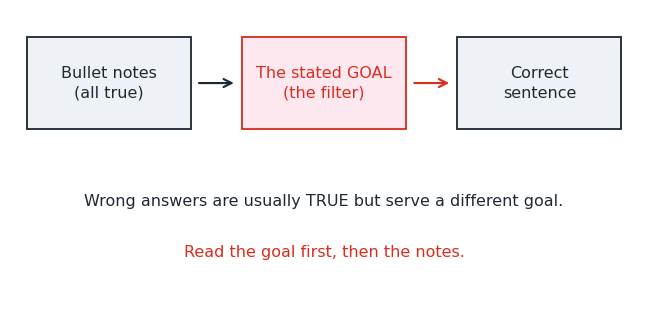
Below, the same notes could support several true sentences — only one meets the stated goal.
Worked examples
Notes: Marie Curie and Lise Meitner were pioneering women in nuclear science. Curie was the first woman to win a Nobel Prize and the only person to win in two different scientific fields. Meitner co-discovered nuclear fission but was excluded from the 1944 Nobel Prize, awarded solely to her collaborator Otto Hahn. Curie's work laid the foundation for X-ray machines, while Meitner's contributions were critical to understanding atomic energy.
The student wants to compare the two women's contributions to nuclear science. Which choice most effectively accomplishes this goal?
- ACurie and Meitner both made groundbreaking contributions; Curie, for example, won two Nobel Prizes.
- BCurie's research earned her two Nobel Prizes, while Meitner's collaboration on fission was pivotal, even though she was not recognized with a Nobel.
- CMany women, including Curie and Meitner, contributed to nuclear science, but only Curie received a Nobel Prize.
- DAlthough Curie's work led to practical applications like X-ray machines, Meitner's theoretical contributions were essential to the discovery of nuclear fission.
The goal is to compare their contributions to nuclear science. So the sentence must set the substance of each woman's work side by side.
(D) is correct: practical applications against theoretical contributions — a genuine comparison of what each contributed.
(B) is the trap. It mentions both women, but it compares their recognition — prizes awarded and withheld — rather than their contributions.
(A) names only Curie's achievement, so nothing is compared.
(C) is about who received recognition, and drifts into a general claim about women in the field.
Notes from a study projecting economic damages from climate change across 1,600 regions: the world economy is committed to an income reduction of 19% within 26 years independent of future emissions; these damages outweigh the cost of limiting warming to 2°C by sixfold; damages arise predominantly through changes in average temperature, but further climatic components raise estimates by about 50%; losses are projected for all regions except those at very high latitudes.
A student wants to summarize the study's findings. Which choice most effectively accomplishes this goal?
- AThe study finds that regions at very high latitudes might benefit due to reductions in temperature variability.
- BThe study suggests accounting for other climatic components raises the damages estimate by 50%.
- CThe study uses data from over 1,600 regions and emphasizes considering daily temperature variations.
- DThis study predicts a global economic blow: a 19% income reduction within 26 years due to climate change, irrespective of future emissions. Temperature is the main culprit, but other factors can worsen the impact by 50%.
A summary must carry the study's headline finding, not one subsidiary detail. The headline here is the 19% income reduction.
(D) is correct: it leads with the main result and adds the key qualification.
(A) and (B) are both true, and both report single details — an exception and a secondary adjustment.
(C) describes the study's method rather than its findings.
Both questions share a shape: several true sentences, one goal, and the goal decides. Name the goal in your own words before reading any choice.
Is rhetorical synthesis costing you points?
Take the free 10-question diagnostic for a predicted SAT score and a breakdown of which domains are costing you points.