Introduction to Vertex form of a parabola
An SAT Math micro-topic under Quadratic graphs (Advanced Math). Free to read — no account needed.
In vertex form , the vertex sits at .
It is the turning point of the parabola — the lowest point when it opens up, the highest when it opens down.
The constant decides the direction and the shape.
It is the turning point of the parabola — the lowest point when it opens up, the highest when it opens down.
The constant decides the direction and the shape.
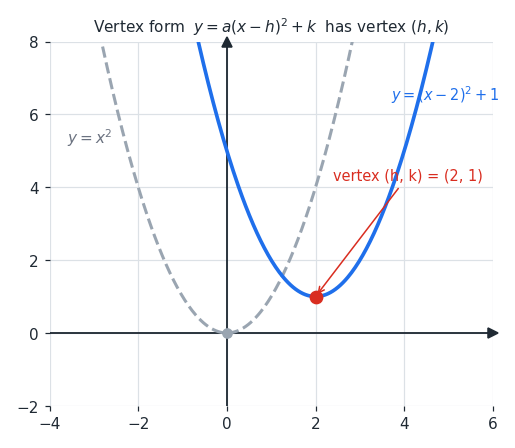
The figure shows a parabola in vertex form.
The vertex is at the bottom here because .
The dashed line through the vertex is the axis of symmetry, the vertical line .
The vertex is at the bottom here because .
The dashed line through the vertex is the axis of symmetry, the vertical line .
Watch the subtraction inside the bracket: .
A vertex at gives , while a vertex at gives .
So a plus sign inside the bracket means is negative.
A vertex at gives , while a vertex at gives .
So a plus sign inside the bracket means is negative.
The value of also controls the shape.
A larger makes the parabola narrower, and a smaller makes it wider.
But it does not move the vertex, which stays at .
A larger makes the parabola narrower, and a smaller makes it wider.
But it does not move the vertex, which stays at .
Worked examples
What is the vertex of ?
Compare it to : and .
So the vertex is .
Compare it to : and .
So the vertex is .
What is the vertex of ?
Write as , so and .
The vertex is , and since , the parabola opens downward.
Write as , so and .
The vertex is , and since , the parabola opens downward.
Write the vertex form of a parabola with vertex .
Substitute and into .
This gives .
Substitute and into .
This gives .
Is this one of the topics costing you points?
Take the free 10-question diagnostic for a predicted SAT score and a breakdown of which domains are costing you points.