No solution to a system of equations
An SAT Math micro-topic under Solving systems of linear equations (Algebra). Free to read — no account needed.
When a system of two lines has no solution, it means the lines never intersect.
The only way two straight lines never meet is if they are parallel.
Parallel lines have the same slope but different -intercepts.
The only way two straight lines never meet is if they are parallel.
Parallel lines have the same slope but different -intercepts.
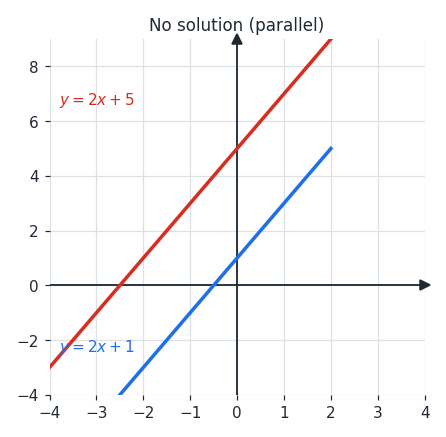
The figure shows two parallel lines.
They rise at the same rate, so they stay the same distance apart and never cross.
With no crossing point, no pair works in both equations.
They rise at the same rate, so they stay the same distance apart and never cross.
With no crossing point, no pair works in both equations.
The algebra shows this as a contradiction.
Setting cancels the terms and leaves , which is false.
A false statement like that means the system has no solution.
Setting cancels the terms and leaves , which is false.
A false statement like that means the system has no solution.
You can also check the coefficients.
For and , there is no solution when .
The slopes match but the constants do not, so the lines are parallel.
For and , there is no solution when .
The slopes match but the constants do not, so the lines are parallel.
Worked examples
How many solutions does the system and have?
Both lines have slope but different -intercepts, so they are parallel.
The system has no solution.
Both lines have slope but different -intercepts, so they are parallel.
The system has no solution.
Two lines have slopes and and different -intercepts. What value of gives no solution?
For parallel lines the slopes must be equal: , so .
With different intercepts, the lines are parallel and the system has no solution.
For parallel lines the slopes must be equal: , so .
With different intercepts, the lines are parallel and the system has no solution.
Solve the system and .
Set them equal: , which gives .
That is impossible, so the system has no solution.
Set them equal: , which gives .
That is impossible, so the system has no solution.
Is this one of the topics costing you points?
Take the free 10-question diagnostic for a predicted SAT score and a breakdown of which domains are costing you points.