An SAT Math micro-topic under Solving systems of linear equations (Algebra). Free to read — no account needed.
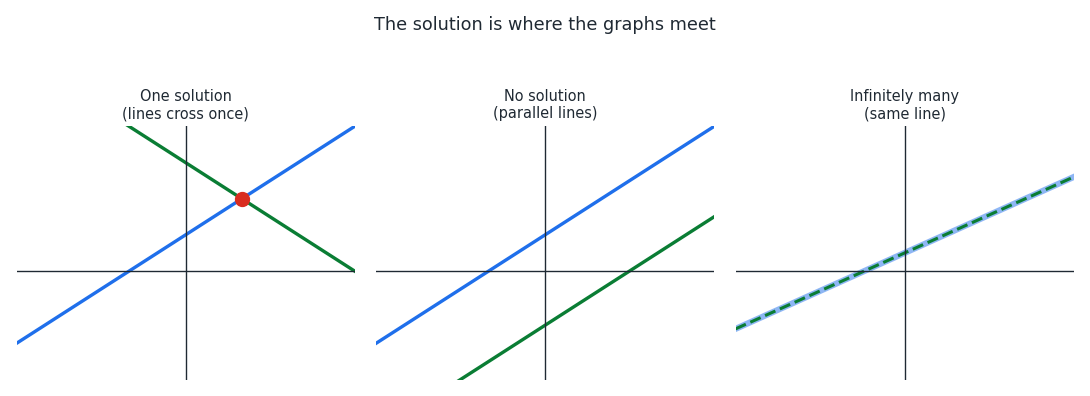
A system of two linear equations is solved wherever the lines meet. When the lines have different slopes, they cross at exactly one point, so the system has exactly one solution.
Compare the slopes to decide. Different slopes means the lines must eventually cross once — one solution. The same slope means the lines are parallel, giving either no solution (different intercepts) or infinitely many (the same line).
So the quickest check is to look at the slopes. Put both equations in the form y=mx+b and compare the m values. If the m values differ, there is one solution.
You can then find that one solution by solving the system. Setting the two expressions for y equal, or using elimination, gives the single (x,y) point where the lines meet.
Worked examples
A system of equations is y=3x+4 and y=4x+4. How many solutions does it have? The slopes are 3 and 4, which are different, so the lines cross at exactly one point. So the system has one solution, at (0,4).
A system of equations is y=2x+1 and y=2x−3. How many solutions does it have? Both lines have slope 2 but different intercepts, so they are parallel and never meet. So the system has no solution, not one.
Find the one solution of the system y=x+2 and y=3x−4. The slopes 1 and 3 differ, so there is one solution; set the sides equal: x+2=3x−4, giving 6=2x and x=3. Then y=3+2=5, so the solution is (3,5).
Is this one of the topics costing you points?
Take the free 10-question diagnostic for a predicted SAT score and a breakdown of which domains are costing you points.