Central Idea and Details
How the SAT tests this, with worked examples — plus the 3 skills it covers. Free to read, no account needed.
A central idea question asks for the statement that captures what the whole passage is doing. A detail question asks what one part says. The answer choices are built to blur that line.
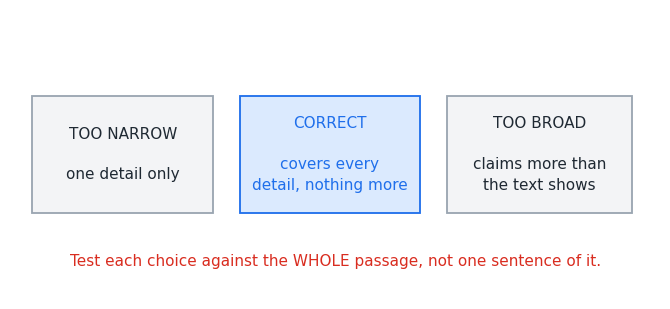
Watch it happen on two very different passages.
Worked examples
This excerpt is taken from Harper Lee's "To Kill a Mockingbird": Mockingbirds don't do one thing but make music for us to enjoy. They don't eat up people's gardens, don't nest in corncribs, they don't do one thing but sing their hearts out for us. That's why it's a sin to kill a mockingbird.
What is the central idea of the text?
- AThe text describes the beauty of mockingbirds' songs.
- BThe text discusses the sinfulness of killing mockingbirds.
- CThe text emphasizes the harmful actions of mockingbirds.
- DThe text explores the role of mockingbirds as pests.
Every sentence builds toward the last one: mockingbirds do no harm, therefore killing them is a sin. The passage is making a case, and that conclusion is its point.
(B) is correct.
(A) is true but too narrow — the songs are one piece of evidence for the larger claim, not the claim itself.
(C) and (D) state the opposite of the passage, which explicitly lists what mockingbirds do not do.
(A) is the dangerous one. It is accurate, and you can point at the line supporting it. It is still wrong, because it covers only part of the passage.
From a research article titled "The Role of Neurotransmitters in Depression": Depression is believed to be influenced by genetics, environment, and neurotransmitter imbalances. One key neurotransmitter is serotonin, which regulates mood, sleep, and appetite. Research shows individuals with depression often have lower serotonin levels, leading to symptoms such as persistent sadness, fatigue, and changes in appetite. Other neurotransmitters such as dopamine and norepinephrine have also been linked to depression.
How do neurotransmitter imbalances contribute to the development of depression?
- AAll people with lower levels of serotonin automatically experience depression.
- BPeople with depression have abnormally high levels of all neurotransmitters.
- CNeurotransmitter imbalances are primarily caused by lifestyle choices such as poor diet.
- DNeurotransmitter imbalances, particularly low serotonin levels, can lead to symptoms of depression.
The passage says low serotonin is often found and can lead to symptoms. Match that strength of claim exactly.
(D) is correct, and notice its careful wording: can lead to, not always causes.
(A) overstates it into a universal rule the passage never makes — the word automatically is the giveaway.
(B) reverses the finding; the passage says levels are lower, not higher.
(C) introduces lifestyle causes that appear nowhere in the text.
Here the trap was overstatement rather than narrowness. A choice can fail by covering too little or by claiming too much.
Is central idea and details costing you points?
Take the free 10-question diagnostic for a predicted SAT score and a breakdown of which domains are costing you points.