Linear equation word problems
How the SAT tests this, with worked examples — plus the 4 skills it covers. Free to read, no account needed.
These questions describe a situation in words and ask you to model it, almost always with . The difficulty is translation, not algebra.
A small vocabulary maps phrases onto parts of the equation reliably.
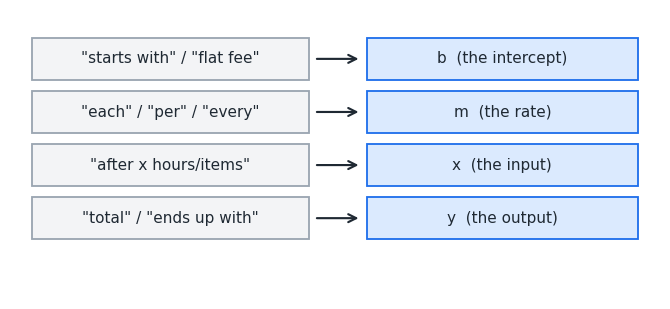
A fixed amount that exists before anything happens is the intercept : a joining fee, a starting balance, an initial temperature. An amount that repeats per unit is the rate : per hour, per mile, each month.
So "a gym charges a joining fee plus a month" becomes , where is months and is total cost. The reliable test is asking which number happens once and which repeats.
Watch for questions asking what a value means in context rather than asking you to solve. In , the is the monthly charge and the the one-off fee — and the answer choices will offer those two swapped.
Worked examples
A plumber charges a call-out fee plus per hour. Write the cost for hours.
The call-out happens once, so it is the intercept; the hourly rate repeats
The call-out happens once, so it is the intercept; the hourly rate repeats
A tank holds litres and drains at litres per minute. Write the volume after minutes.
The starting amount is the intercept, and the rate is negative because the volume falls
The starting amount is the intercept, and the rate is negative because the volume falls
For , what does the represent?
- AThe cost per hour
- BThe fixed call-out fee
It is the value of when , so it is the charge before any hours are worked, making (B) correct. (A) describes the .
Is linear equation word problems costing you points?
Take the free 10-question diagnostic for a predicted SAT score and a breakdown of which domains are costing you points.