Linear inequality word problems
How the SAT tests this, with worked examples — plus the 2 skills it covers. Free to read, no account needed.
These are linear word problems whose answer is a range rather than a single value. The modelling is identical; the extra step is turning a phrase into the right inequality sign.
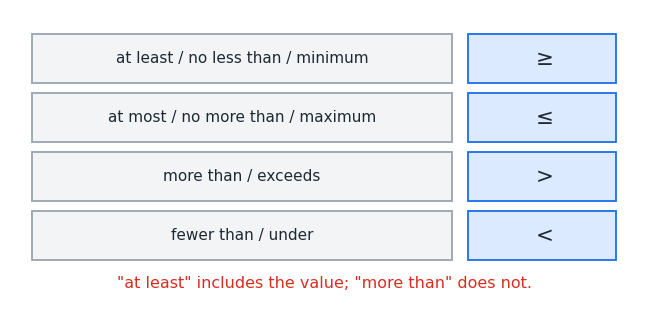
The distinction that matters is whether the boundary value itself counts. At least and no more than include it, giving and . More than and fewer than exclude it, giving and .
So "a budget of at most " becomes , while "more than 10 attendees" becomes .
Solve exactly as you would an equation, with one exception: multiplying or dividing by a negative number flips the sign.
Finally, check the answer against the situation. Counts of people or items must be whole numbers, so a solution of means or more — and the answer choices will include for anyone who stops at the algebra.
Worked examples
Tickets cost each and the budget is at most . How many can be bought?
At most includes the boundary
At most includes the boundary
Tickets are whole, so at most .
A van holds more than boxes but no more than . Write this as an inequality.
More than excludes ; no more than includes
More than excludes ; no more than includes
Is linear inequality word problems costing you points?
Take the free 10-question diagnostic for a predicted SAT score and a breakdown of which domains are costing you points.