Linear relationship word problems
How the SAT tests this, with worked examples — plus the 3 skills it covers. Free to read, no account needed.
A linear relationship is one where a quantity changes by the same amount each step. The model is , and the work is deciding which number in the words is the rate and which is the starting value.
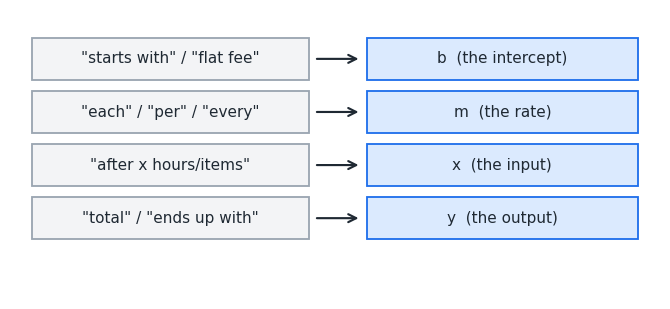
The number that happens once, before anything else, is the intercept . The number that repeats per unit is the rate . A fee of plus a month gives .
When a question gives you two data points instead of a rate, find the rate yourself
then substitute one point back to get .
A decreasing quantity simply has a negative rate. A tank draining at litres a minute from litres is .
Many questions never ask you to solve. They ask what a number means in context, and the answer choices offer the rate and the starting value swapped — so always check which one happens repeatedly.
Worked examples
A membership costs to join and a month. Write the total cost after months.
The joining fee happens once; the monthly charge repeats
The joining fee happens once; the monthly charge repeats
A plant is cm tall after weeks and cm after weeks. Find the weekly growth rate.
Use the change in each quantity
Use the change in each quantity
For , what does mean?
- AThe monthly charge
- BThe cost before any months have passed
It is when , so (B) is correct. (A) describes .
Is linear relationship word problems costing you points?
Take the free 10-question diagnostic for a predicted SAT score and a breakdown of which domains are costing you points.