Operations with polynomials
How the SAT tests this, with worked examples — plus the 1 skills it covers. Free to read, no account needed.
Adding, subtracting and multiplying polynomials follows the ordinary rules of algebra, with one idea doing most of the work: only like terms combine.
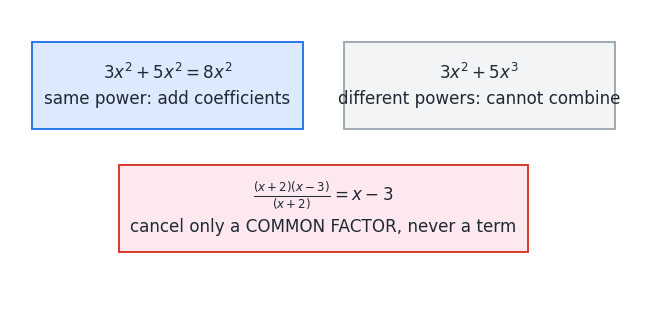
Like terms have the same variable raised to the same power. So and combine to , while and cannot be combined at all.
When subtracting, the minus sign applies to every term in the bracket. Forgetting to distribute it past the first term is the most frequent error here, and the resulting wrong answer is always offered.
To multiply, every term in the first bracket multiplies every term in the second, then collect like terms. Two patterns recur often enough to recognise instantly: and .
Note that is not . The missing middle term is one of the most reliably tested mistakes on the exam.
Worked examples
Simplify .
Distribute the minus across both terms
Distribute the minus across both terms
Note the became .
Expand .
- A
- B
Squaring a sum produces a middle term , so (B) is correct. (A) is the classic omission.
Is operations with polynomials costing you points?
Take the free 10-question diagnostic for a predicted SAT score and a breakdown of which domains are costing you points.