Percentages
How the SAT tests this, with worked examples — plus the 4 skills it covers. Free to read, no account needed.
Percent means out of one hundred, so is . Converting to a decimal first makes nearly every question here mechanical.
To increase by , multiply by ; to decrease by , multiply by . Using multipliers rather than working out the change and adding it separately avoids most errors and makes repeated changes easy.
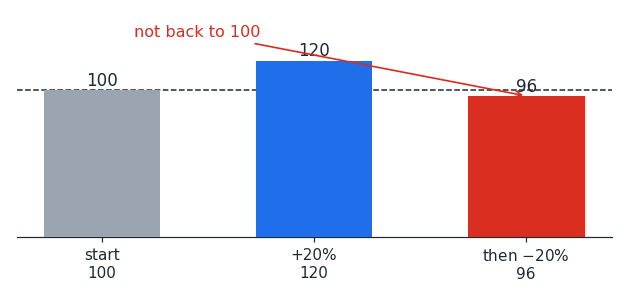
That picture shows the most tested idea in the topic. An increase followed by a decrease of the same percentage does not return you to where you started, because the second percentage is taken of a larger number.
Percent change compares the change to the original amount
Dividing by the new value instead is the single commonest mistake, and that wrong answer is always offered.
Reverse questions give you the final amount and ask for the original. Divide rather than multiply: if a price after a rise is , the original was .
Worked examples
A price of rises by . What is the new price?
Multiply by the increase multiplier
Multiply by the increase multiplier
A value goes from to . What is the percent increase?
Compare the change with the original
Compare the change with the original
Dividing by instead gives about , which will be among the choices.
A jacket costs {
$66} after a {12
$66} after a {12
%} discount. What was the original price?
- A{
$73.92}
(B) {
$75}
The sale price is of the original, so divide: {
frac = 75}, making (B) correct. (A) adds {12
%} to the sale price, which is the trap.
(B) {
$75}
The sale price is of the original, so divide: {
frac = 75}, making (B) correct. (A) adds {12
%} to the sale price, which is the trap.
Is percentages costing you points?
Take the free 10-question diagnostic for a predicted SAT score and a breakdown of which domains are costing you points.