Right triangle trigonometry
How the SAT tests this, with worked examples — plus the 2 skills it covers. Free to read, no account needed.
In a right triangle the three ratios are fixed by the angle, which is what makes trigonometry useful: one angle and one side give you the rest.
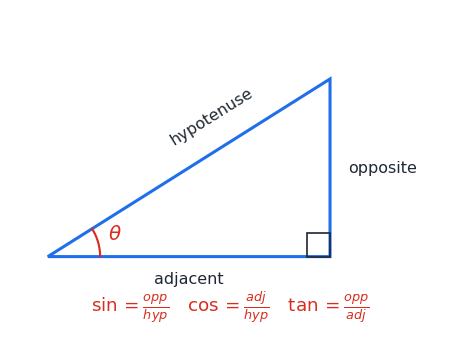
The labels are relative to the angle you are using. The hypotenuse is always opposite the right angle, but which of the other two sides counts as opposite and which as adjacent changes depending on which angle you pick. Mislabelling here causes more errors than the formulas themselves.
Alongside these, Pythagoras gives whenever you have two sides and want the third without any angle.
Two special triangles appear repeatedly and are worth recognising: the -- with sides in ratio , and the -- with sides . Spotting one often removes the need for any calculation.
One relationship the SAT tests directly: the sine of an angle equals the cosine of its complement, so .
Worked examples
A right triangle has legs and . Find the hypotenuse.
Apply Pythagoras
Apply Pythagoras
In a right triangle, the side opposite is and the hypotenuse is . Find .
Sine is opposite over hypotenuse
Sine is opposite over hypotenuse
If , what is ?
The angles are complementary, since , and sine of an angle equals cosine of its complement. So .
The angles are complementary, since , and sine of an angle equals cosine of its complement. So .
Is right triangle trigonometry costing you points?
Take the free 10-question diagnostic for a predicted SAT score and a breakdown of which domains are costing you points.