Solving linear equations and inequalities
How the SAT tests this, with worked examples — plus the 3 skills it covers. Free to read, no account needed.
Solving a linear equation means undoing whatever was done to the variable, in reverse order, doing the same thing to both sides each time. That is the whole method, and it does not change no matter how cluttered the equation looks.
Inequalities work identically with one exception that the SAT tests constantly: multiplying or dividing by a negative number flips the inequality sign. Adding or subtracting a negative does not.
The more interesting questions ask not for a solution but for how many solutions exist. A linear equation has one solution when the variable survives, no solution when it cancels and leaves something false, and infinitely many when it cancels and leaves something true.
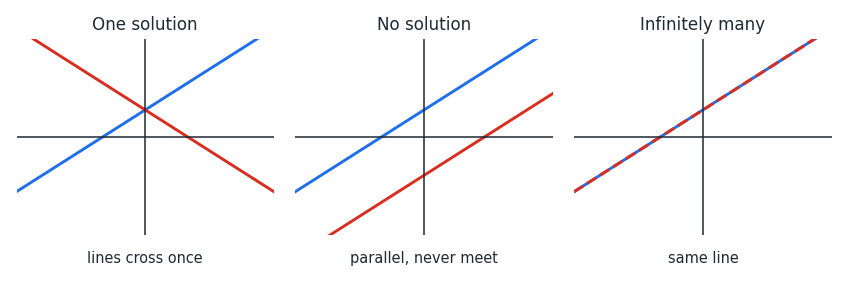
Seen as graphs, that is just two lines: crossing once, parallel and never meeting, or lying exactly on top of each other. The algebra and the picture are the same fact.
So when a question gives and asks for the value of making it have no solution, it is asking you to make the slopes equal while keeping the intercepts different.
Worked examples
Solve .
Collect the variable on one side and the numbers on the other
Collect the variable on one side and the numbers on the other
The variable survived, so there is exactly one solution.
For what value of does have no solution?
- A
- B
No solution means the terms cancel and leave a false statement. That needs , which gives , which is false. So (A) is correct. Had the constants also matched, there would have been infinitely many solutions instead.
Solve .
Subtract from both sides to get . Now divide by , which flips the sign
Subtract from both sides to get . Now divide by , which flips the sign
Forgetting to flip gives , which is exactly the wrong half of the number line — and is always among the answer choices.
Is solving linear equations and inequalities costing you points?
Take the free 10-question diagnostic for a predicted SAT score and a breakdown of which domains are costing you points.