Unit circle trigonometry
How the SAT tests this, with worked examples — plus the 2 skills it covers. Free to read, no account needed.
On a circle of radius centred at the origin, the point at angle has coordinates . That single fact drives everything here.
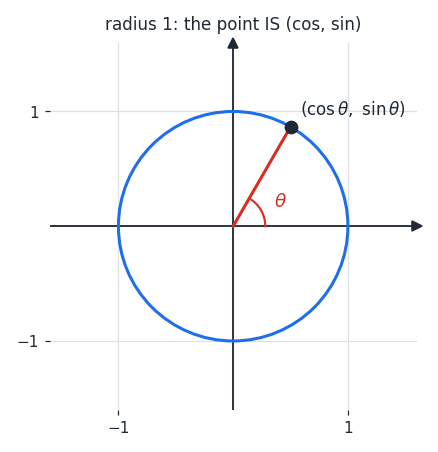
Because the radius is , cosine is simply the -coordinate and sine the -coordinate. So the sign of each is decided by the quadrant: both positive in the first, sine only in the second, both negative in the third, cosine only in the fourth.
Angles can be measured in degrees or radians, and converting between them uses radians. So is and is .
Two relationships are worth knowing. The Pythagorean identity follows directly from the circle's equation, and .
Most SAT questions here are conversions, quadrant-sign questions, or a single use of the identity — not heavy trigonometric manipulation.
Worked examples
Convert radians to degrees.
Use
Use
If is in the second quadrant, what are the signs of and ?
The second quadrant has negative and positive , so and .
The second quadrant has negative and positive , so and .
If and is in the first quadrant, find .
Apply the identity
Apply the identity
The first quadrant makes cosine positive, so rather than .
Is unit circle trigonometry costing you points?
Take the free 10-question diagnostic for a predicted SAT score and a breakdown of which domains are costing you points.