An SAT Math micro-topic under Probability and relative frequency (Problem solving and data analysis). Free to read — no account needed.
Every probability is a fraction: total outcomesfavorable outcomes. The total number of outcomes is the denominator — it counts all the results that could possibly happen.
For a single choice, the total is simply how many options there are. A bag with 5 red, 3 blue, and 2 green marbles has 5+3+2=10 possible outcomes for one draw.
When something happens in stages, multiply the number of choices at each stage. If the item is replaced each time, the count stays the same: drawing 3 balls from 50 with replacement gives 50×50×50 outcomes. If it is not replaced, the count drops each time: drawing 3 balls from 15 gives 15×14×13.
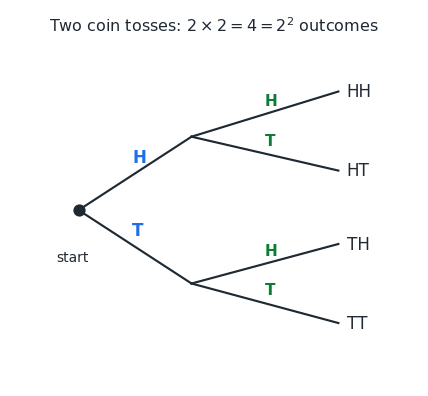
For a two-way event repeated several times, the total doubles each time. One coin toss has 2 outcomes, two tosses have 2×2=4, and n tosses have 2n.
When the outcomes come in separate groups, add the group sizes to get the total. If a library has 580, 1350, and 2680 books in three sections, the total number of books to choose from is their sum, 4610.
Worked examples
A jar holds 4 red, 3 blue, and 2 green candies. How many possible outcomes are there when you draw one candy? Count every candy you could draw: 4+3+2=9. So there are 9 total outcomes.
Two cards are drawn one after another from a set of 12 cards, without replacement. How many outcomes are possible if the order matters? The first card can be any of 12, and the second any of the remaining 11. So the total is 12×11=132.
A standard six-sided die is rolled twice. How many total outcomes are there? Each roll has 6 possible results, and the rolls are independent. So the total is 6×6=36.
Is this one of the topics costing you points?
Take the free 10-question diagnostic for a predicted SAT score and a breakdown of which domains are costing you points.