An SAT Math micro-topic under Probability and relative frequency (Problem solving and data analysis). Free to read — no account needed.
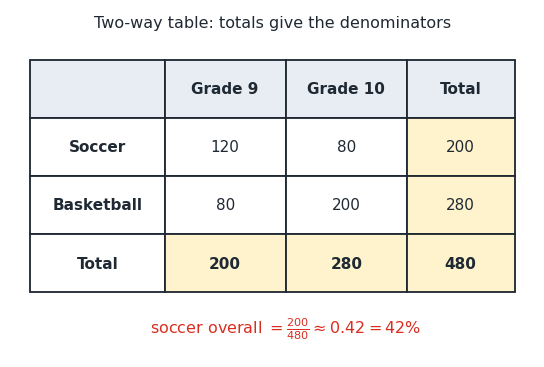
Relative frequency compares a part to the whole. You take the count in a category and divide by the total: totalcount. For example, if 200 of 480 students prefer soccer, the relative frequency of soccer is 480200.
The same value can be written three ways. As a fraction it is 480200, as a decimal about 0.42, and as a percent about 42%. To turn a decimal into a percent, multiply by 100.
Two-way tables organize counts by two categories at once, with row totals, column totals, and one grand total. Every relative frequency is one count divided by one of these totals.
The most common mistake is dividing by the wrong total. "What fraction of daily exercisers are vegan?" uses the daily-exerciser total as the denominator, not the grand total. Always ask which group the question is treating as the whole.
You can also work backwards. If you know the relative frequency and the total, multiply them to get the count. A relative frequency of 0.24 out of 500 plants means 0.24×500=120 plants.
Worked examples
Out of 120 people surveyed, 30 chose tea as their favorite drink. What is the relative frequency of tea? Relative frequency is the count over the total: 12030. This equals 0.25, or 25%.
In a study, 280 people exercise daily, and 84 of them follow a vegan diet. What fraction of daily exercisers are vegan? The group being asked about is daily exercisers, so the total is 280. So the relative frequency is 28084=0.30=30%.
The relative frequency of plants between 10 and 15 cm tall is 0.24, and there are 500 plants in total. How many plants are in that range? Multiply the relative frequency by the total: 0.24×500. So there are 120 plants in that range.
Is this one of the topics costing you points?
Take the free 10-question diagnostic for a predicted SAT score and a breakdown of which domains are costing you points.