Angles basics
An SAT Math micro-topic under Congruence, similarity, and angle relationships (Geometry and trigonometry). Free to read — no account needed.
Most angle questions are solved by combining a small set of facts, one step at a time. Around a single point the angles make a full turn, so they add to . Angles that sit on a straight line are supplementary, adding to . And when two lines cross, the angles directly across from each other, called vertically opposite angles, are equal.
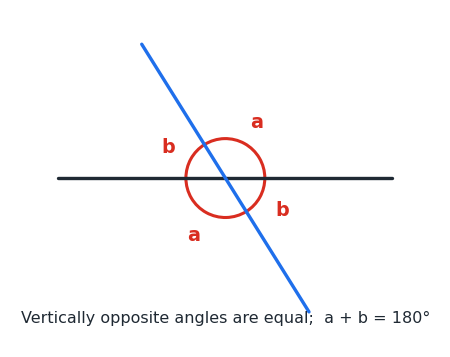
In this figure of two crossing lines, the angles marked are vertically opposite and so are equal, as are the two marked ; since an and a neighbouring lie together on a straight line, .
When a transversal crosses two parallel lines, eight angles are formed, numbered 1 to 8 in the figure below.
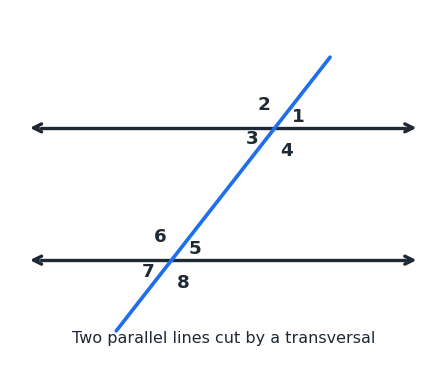
Three relationships unlock all of them. Corresponding angles occupy the same position at the two crossings and are equal, for example angle 4 and angle 8. Alternate angles lie on opposite sides of the transversal and between the two lines, and they are equal too, for example angle 4 and angle 6. Co-interior (same-side) angles sit between the lines on the same side of the transversal and are supplementary, adding to , for example angle 4 and angle 5.
The skill is chaining these facts: find one angle, use it to get the next, and continue. For instance, a vertically opposite angle gives you one value, a corresponding angle carries that value to a second angle, and a supplementary pair then gives a third. Each step uses just one fact.
Worked examples
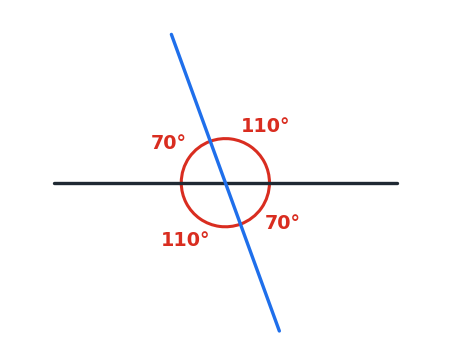
Two lines cross so that one angle is . Its vertically opposite angle is also , and each angle next to it on the straight line is .
A transversal crosses two parallel lines. If one angle is , the corresponding angle on the other parallel line is also , and the co-interior angle on the same side is .
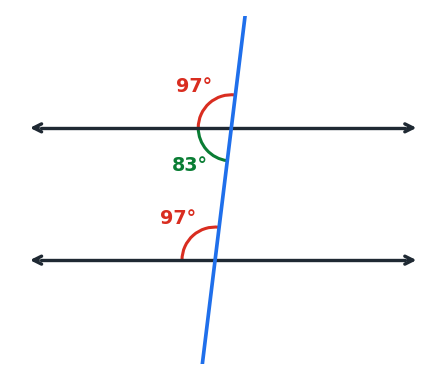
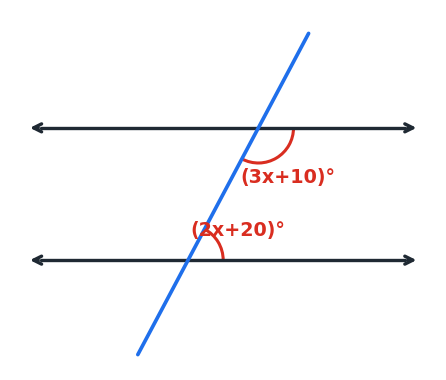
Two co-interior angles are and . Since they are supplementary, , so , giving .
Is this one of the topics costing you points?
Take the free 10-question diagnostic for a predicted SAT score and a breakdown of which domains are costing you points.