An SAT Math micro-topic under Congruence, similarity, and angle relationships (Geometry and trigonometry). Free to read — no account needed.
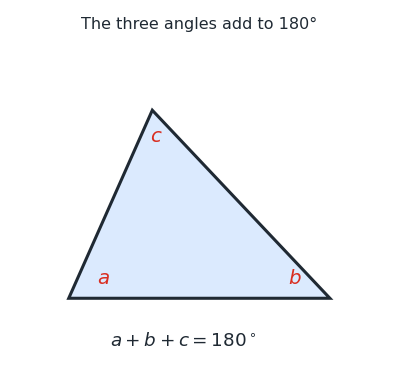
Every triangle has three sides and three angles. No matter its shape, the three angles always add to 180∘. So if you know two of the angles, you can find the third by subtracting from 180∘.
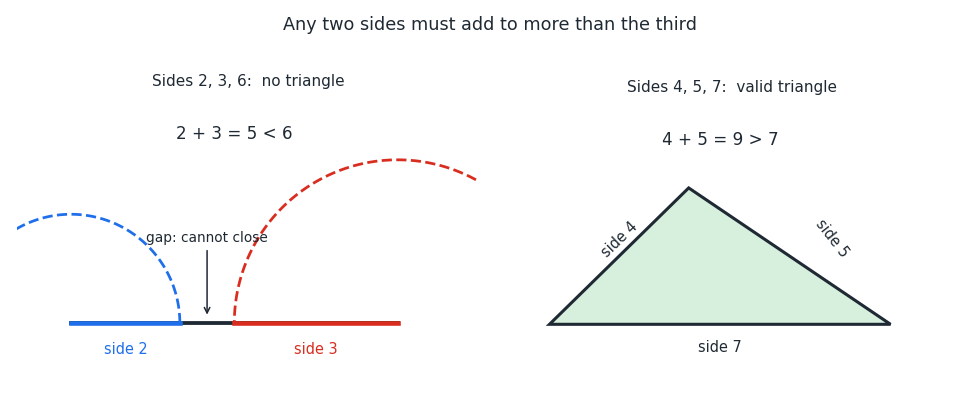
For any triangle, no matter its type, the sum of any two side lengths must be greater than the third side. This is the triangle inequality. If two sides are too short to reach across the third, they cannot meet to close the triangle. For example, sides of 2, 3, and 6 cannot form a triangle, because 2+3=5, which is less than 6.
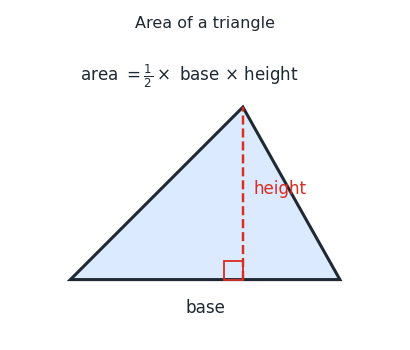
The area of a triangle is 21×base×height. The height must be measured straight up from the base at a right angle, not along a slanted side.
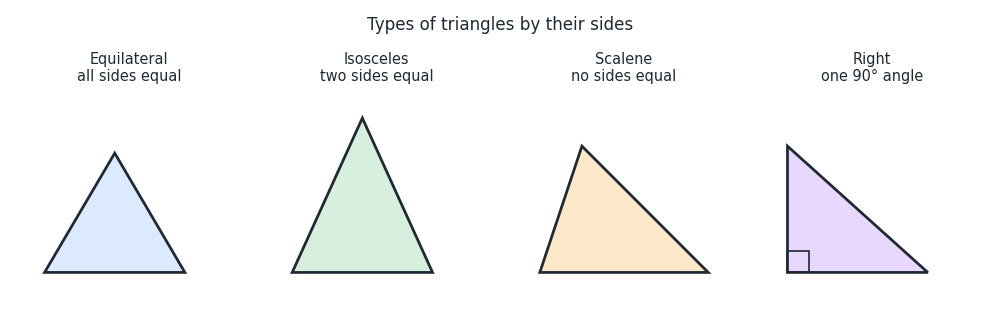
Triangles are grouped by their sides. An equilateral triangle has all three sides equal, an isosceles has two sides equal, and a scalene has no sides equal. In an isosceles triangle, the two angles opposite the equal sides are also equal.
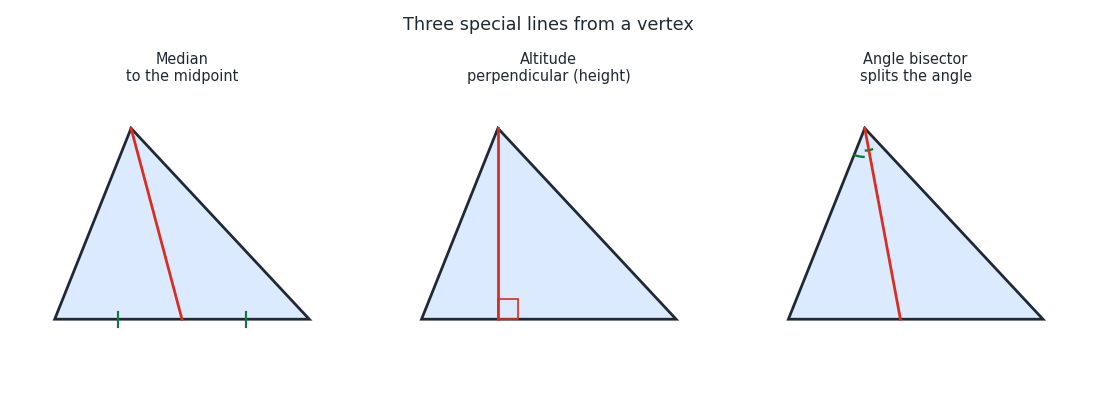
Three special lines can be drawn from a vertex. A median goes from a vertex to the midpoint of the opposite side. An altitude goes from a vertex straight to the opposite side at a right angle — it is the height. An angle bisector cuts the vertex's angle into two equal halves.
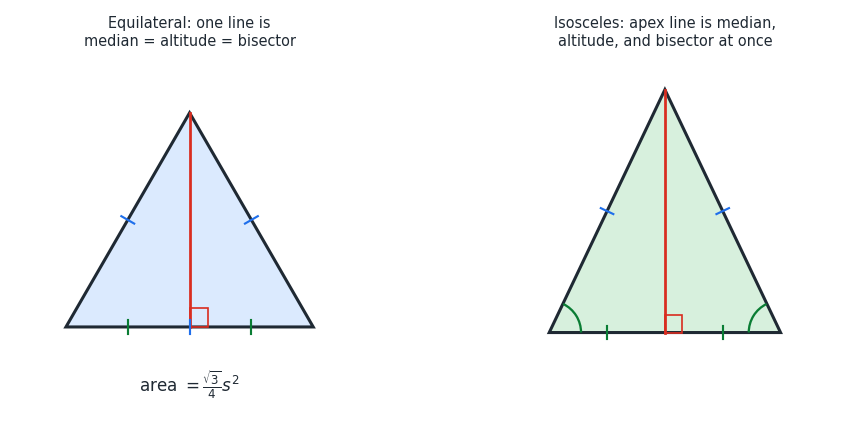
In an equilateral triangle (all sides equal, all angles 60∘), these lines all coincide. From each vertex, the median, altitude, angle bisector, and perpendicular bisector are the very same line. Its area has a special formula: area=43s2, where s is the side length.
In an isosceles triangle, the line from the apex (the vertex between the two equal sides) down to the base is also all of these at once. It is the median, the altitude, the angle bisector, and the perpendicular bisector of the base, all in one. That single line splits the isosceles triangle into two identical halves.
The size of an angle matches the side across from it. The largest angle sits opposite the longest side, and the smallest angle opposite the shortest side.
A right triangle has one 90∘ angle. Its longest side, called the hypotenuse, lies opposite that right angle. The three sides obey the Pythagorean theorem, a2+b2=c2, where c is the hypotenuse.
Worked examples
Two angles of a triangle are 50∘ and 70∘. What is the third angle? The three angles add to 180∘. So the third angle is 180∘−50∘−70∘=60∘.
Can three sticks of length 4, 6, and 11 form a triangle? Check the two shorter sides against the longest: 4+6=10. Since 10 is less than 11, the two shorter sides cannot reach across. So no, they cannot form a triangle.
A triangle has a base of 10 and a height of 6. What is its area? The area is 21×base×height. So it is 21×10×6=30.
An equilateral triangle has a side length of 6. What is its area? Use the equilateral area formula 43s2 with s=6. So the area is 43(6)2=43(36)=93.
A right triangle has legs of length 9 and 12. How long is the hypotenuse? Use the Pythagorean theorem a2+b2=c2. So c2=92+122=81+144=225, giving c=225=15.
Two sides of a triangle are 5 and 8. What is the range of possible lengths for the third side? By the triangle inequality, the third side must be less than the sum 5+8=13. It must also be more than the difference 8−5=3. So the third side is between 3 and 13.
Is this one of the topics costing you points?
Take the free 10-question diagnostic for a predicted SAT score and a breakdown of which domains are costing you points.