Properties of similar triangles
An SAT Math micro-topic under Congruence, similarity, and angle relationships (Geometry and trigonometry). Free to read — no account needed.
Similar triangles have the same shape but can differ in size.
Their corresponding angles are equal, and their corresponding sides are proportional.
These two facts are what "similar" means.
Their corresponding angles are equal, and their corresponding sides are proportional.
These two facts are what "similar" means.
To show two triangles are similar, you usually check the angles.
If two pairs of corresponding angles are equal, the triangles are similar — this is the angle-angle (AA) rule, and the third pair is then automatically equal.
A line parallel to one side of a triangle creates equal angles, so it cuts off a triangle similar to the whole.
If two pairs of corresponding angles are equal, the triangles are similar — this is the angle-angle (AA) rule, and the third pair is then automatically equal.
A line parallel to one side of a triangle creates equal angles, so it cuts off a triangle similar to the whole.
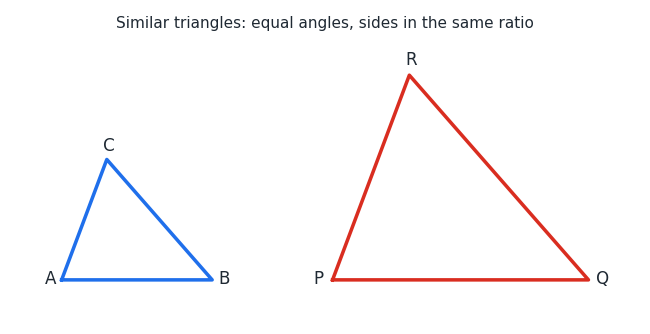
It is important to match up the vertices that have the same angle.
The similarity statement lists them in that order: if , , and , you write .
Corresponding sides then join matching vertices, so — not , because matches , not .
The similarity statement lists them in that order: if , , and , you write .
Corresponding sides then join matching vertices, so — not , because matches , not .
The ratio of the areas is the square of the ratio of the sides.
If corresponding sides are in ratio , the areas are in ratio .
So a triangle with sides times as long has times the area.
If corresponding sides are in ratio , the areas are in ratio .
So a triangle with sides times as long has times the area.
A line parallel to one side gives a ready-made pair of similar triangles.
If is parallel to in , then .
Their corresponding sides are proportional, so .
If is parallel to in , then .
Their corresponding sides are proportional, so .
Worked examples
In , angle is . What is angle ?
The similarity statement matches with , since they are in the same position.
Corresponding angles are equal, so .
The similarity statement matches with , since they are in the same position.
Corresponding angles are equal, so .
In , side and side . What is the ratio ?
Because matches and matches , side corresponds to side .
All corresponding sides share the same ratio, so .
Because matches and matches , side corresponds to side .
All corresponding sides share the same ratio, so .
Triangles and are similar with . If the area of is , what is the area of ?
The side ratio is , so the area ratio is .
So has area .
The side ratio is , so the area ratio is .
So has area .
Is this one of the topics costing you points?
Take the free 10-question diagnostic for a predicted SAT score and a breakdown of which domains are costing you points.