An SAT Math micro-topic under Factoring quadratic and polynomial expressions (Advanced Math). Free to read — no account needed.
Completing the square means rewriting a quadratic like x2+bx+c as a perfect square plus a leftover constant: (x−a)2+k. A perfect square is something like (x−3)2, which multiplies out to x2−6x+9.
The rule is short: to complete x2+bx, add half of b, squared. Take x2−6x: half of −6 is −3, and (−3)2=9, so x2−6x+9=(x−3)2. The number you add is always (2b)2.
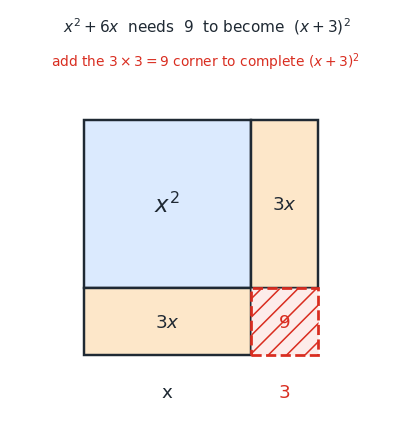
The name comes from a picture. An x2 square with two 2b×x strips forms an L-shape, and it takes one small 2b×2b square to fill the corner and "complete" the big square. That corner square is exactly the (2b)2 you add.
To keep the expression's value the same, you subtract whatever you added. For x2−10x−60, half of −10 is −5, so you add and subtract 25: x2−10x+25−25−60. That is (x−5)2−85, which is now in the form (x−a)2+k.
Worked examples
What constant must be added to x2+8x to make it a perfect square? Take half of 8, which is 4, and square it: 42=16. So adding 16 gives x2+8x+16=(x+4)2.
Write x2−10x−60 in the form (x−a)2+b. Half of −10 is −5, so add and subtract 25: x2−10x+25−25−60. This is (x−5)2−85, so a=5 and b=−85.
Write x2+6x+2 in the form (x+a)2+k. Half of 6 is 3, and 32=9, so add and subtract 9: x2+6x+9−9+2. This is (x+3)2−7.
Is this one of the topics costing you points?
Take the free 10-question diagnostic for a predicted SAT score and a breakdown of which domains are costing you points.