An SAT Math micro-topic under Factoring quadratic and polynomial expressions (Advanced Math). Free to read — no account needed.
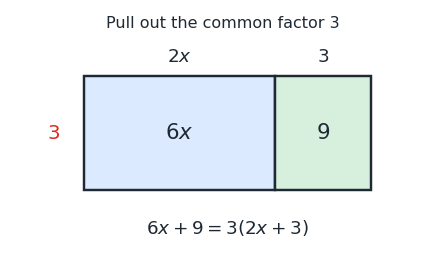
To factor an expression is to rewrite it as things multiplied together. It undoes expanding: expanding turns 3(2x+3) into 6x+9, and factoring turns 6x+9 back into 3(2x+3). Always look first for a greatest common factor — the largest number and variable power shared by every term.
In 6x+9, both terms are divisible by 3, so factor it out: 6x+9=3(2x+3). The same works with variables: in 2x3+3x2, both terms share x2, so 2x3+3x2=x2(2x+3).
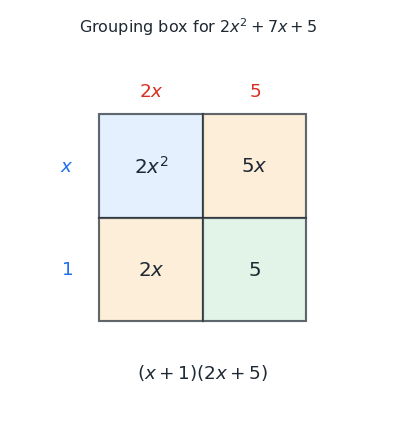
Many quadratics need factoring by grouping. Take 2x2+7x+5. Split the middle term 7x into 2x+5x, giving 2x2+2x+5x+5. Group into pairs and factor each: 2x(x+1)+5(x+1). Both pairs share (x+1), so pull it out: (x+1)(2x+5).
To know how to split the middle term, use a and c. Find two numbers that multiply to a×c and add to b. For 2x2+7x+5, a×c=10 and b=7: the numbers 2 and 5 work, which is why we split 7x into 2x+5x.
Factoring lets you simplify fractions and solve equations. For example, x2−252x+10 factors to (x+5)(x−5)2(x+5), and the (x+5) cancels to leave x−52.
Worked examples
Factor 8x2+12x by pulling out the greatest common factor. Both terms share 4x, since 8x2=4x⋅2x and 12x=4x⋅3. So 8x2+12x=4x(2x+3).
Factor 2x2+7x+3 by grouping. Here a×c=6 and b=7, so the numbers 6 and 1 split the middle term. 2x2+6x+x+3 groups as 2x(x+3)+1(x+3). Both share (x+3), so it factors to (x+3)(2x+1).
Find the greatest common factor of 12x3y2 and 18x2y3. For the numbers, the GCF of 12 and 18 is 6. For each variable, take the lower power: x2 and y2. So the GCF is 6x2y2.
Is this one of the topics costing you points?
Take the free 10-question diagnostic for a predicted SAT score and a breakdown of which domains are costing you points.