Intro to Quadratic equations
An SAT Math micro-topic under Factoring quadratic and polynomial expressions (Advanced Math). Free to read — no account needed.
A quadratic equation is any equation you can write as , with not equal to zero.
The number is the coefficient of , is the coefficient of , and is the constant.
You find them by lining your equation up with this general form.
The number is the coefficient of , is the coefficient of , and is the constant.
You find them by lining your equation up with this general form.
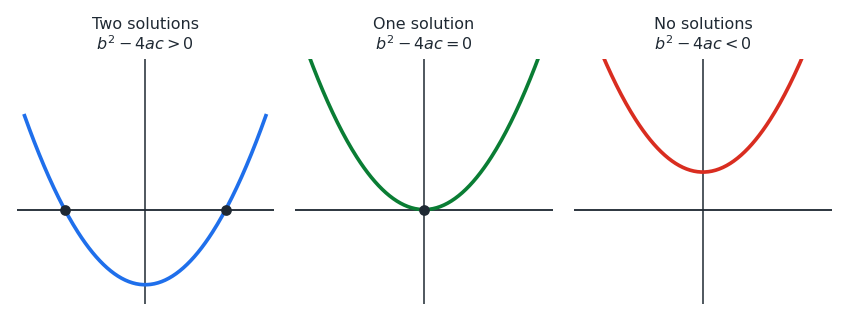
The solutions are the -values where the graph, a parabola, meets the -axis (where ).
As the figure shows, a parabola can cross the axis at two points, touch it at one point, or miss it.
So a quadratic has two, one, or no real solutions.
As the figure shows, a parabola can cross the axis at two points, touch it at one point, or miss it.
So a quadratic has two, one, or no real solutions.
Be careful with signs when reading off , , and .
Rewrite as , so , , and .
The number in front of is , even when it is negative.
Rewrite as , so , , and .
The number in front of is , even when it is negative.
A solution is any value of that makes the equation true.
If is a solution of , substitute it: , so .
Plugging a known solution back in is a quick way to find a missing constant.
If is a solution of , substitute it: , so .
Plugging a known solution back in is a quick way to find a missing constant.
Worked examples
Identify , , and in .
Compare it to .
So , , and .
Compare it to .
So , , and .
Identify , , and in .
Rewrite it as .
So , , and .
Rewrite it as .
So , , and .
If is a solution of , find .
Substitute : .
So and .
Substitute : .
So and .
Is this one of the topics costing you points?
Take the free 10-question diagnostic for a predicted SAT score and a breakdown of which domains are costing you points.