An SAT Reading & Writing micro-topic under Cross texts connections (Craft and Structure). Free to read — no account needed.
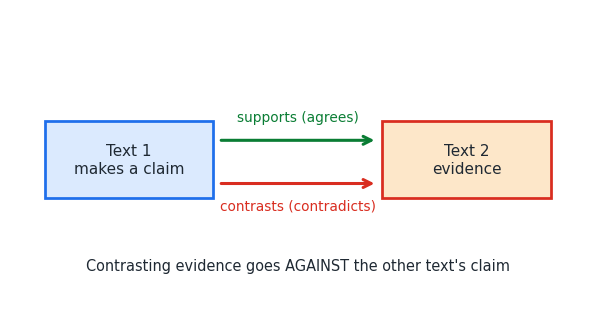
When two texts appear together, a question may ask which piece of evidence would contrast with — contradict or challenge — a claim one of them makes. Supporting evidence agrees with the claim, while contrasting evidence points the opposite way. The clearest way to see the difference is with complete examples.
Text 1: In 1985, Dr. Alvarez dated a set of cave paintings to roughly 12,000 years ago, judging by the style of the animals shown. Text 2: A recent radiocarbon test of pigment scraped from the same paintings returned an age of about 12,000 years, matching Dr. Alvarez's estimate. Which choice would instead provide evidence that CONTRASTS with Dr. Alvarez's dating? Choice A: A separate lab tested charcoal from the rock just beneath the paintings and found it was only 3,000 years old, far too recent for a 12,000-year-old artwork. Choice B: Art historians agree that the animal figures closely resemble other works already known to be about 12,000 years old. Choice A contrasts, because a 3,000-year-old layer means the paintings cannot be 12,000 years old, while Choice B agrees with the dating and so supports it.
Text 1: A historian claims that a 1970s political scandal deepened the public's distrust of the government. Text 2: Newspaper archives from the period show a sharp rise in critical editorials in the months right after the scandal broke. Which choice would instead provide evidence that CONTRASTS with the historian's claim? Choice A: Nationwide opinion polls taken during those same months found that public trust in the government actually held steady. Choice B: Several magazines ran long features examining the damage the scandal did to the government's image. Choice A contrasts, because steady trust means the scandal did not deepen distrust, while Choice B agrees with the claim and so supports it.
In every case, the contrasting evidence is the choice that pushes against the claim, and the supporting choice is the one that agrees with it.
Worked examples
Text 1: A team of linguists argues that a newly found set of symbols is an early form of writing, because the symbols repeat in flexible patterns the way words in a language do. Text 2: A statistical study of the symbols found that their frequencies closely match those of known ancient languages, supporting the linguists' view. Which choice would instead provide evidence that CONTRASTS with the linguists' claim? (A) A follow-up analysis showed the symbols always appear in one fixed, unchanging order, more like a decorative border than a flexible language. (B) Another scholar noted that the symbols were carved with the same careful technique seen in known ancient writing systems. Choice (A) contrasts, because a fixed, unchanging order is unlike a real language and undercuts the claim. Choice (B) agrees with the linguists, so it supports the claim rather than contrasting with it.
Text 1: A biologist proposes that a species of brightly colored frog uses its vivid skin to warn predators that it is poisonous. Text 2: In field observations, birds that ate one of the bright frogs became ill and afterward avoided frogs of the same color, supporting the warning idea. Which choice would instead provide evidence that CONTRASTS with the biologist's claim? (A) A laboratory test found that the bright frogs contain no toxins at all and are completely harmless to eat. (B) Researchers noticed that the frogs' colors look especially vivid in daylight, when predators can see them most clearly. Choice (A) contrasts, because a harmless frog cannot be using its color to warn of poison. Choice (B) fits the warning idea, so it supports the claim rather than contrasting with it.
Text 1: An economist argues that a city's new downtown bike lanes reduced traffic congestion. Text 2: Traffic sensors recorded far fewer cars on the busiest downtown streets in the year after the lanes opened, backing the economist up. Which choice would instead provide evidence that CONTRASTS with the economist's claim? (A) Independent measurements found that average downtown travel times were just as long as before the bike lanes were added. (B) Commuter surveys showed that many people switched from driving to cycling once the new lanes were in place. Choice (A) contrasts, because unchanged travel times mean congestion was not actually reduced. Choice (B) agrees with the economist, so it supports the claim rather than contrasting with it.
Is this one of the topics costing you points?
Take the free 10-question diagnostic for a predicted SAT score and a breakdown of which domains are costing you points.