Cross texts connections
How the SAT tests this, with worked examples — plus the 3 skills it covers. Free to read, no account needed.
These give two short texts and ask how the second relates to the first. The second author might agree, disagree, or accept part of the claim while qualifying the rest.
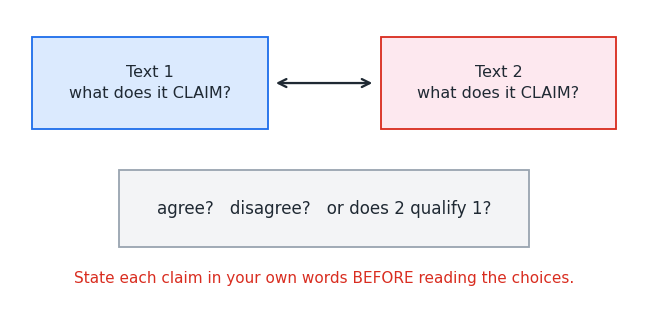
The two questions below land on different answers to that question — one disagreement, one partial agreement.
Worked examples
Text 1: Despite countless reported Bigfoot sightings and blurry photographs, no concrete evidence like bones, DNA, or clear video footage has ever been found. Skeptics point to mistaken identity — large bears can appear ape-like in certain conditions. The lack of physical evidence in heavily forested areas casts doubt on its existence.
Text 2: Proponents point to the consistency in descriptions and argue the lack of physical evidence doesn't disprove existence. Rare animals like the Komodo dragon remained undiscovered for centuries. Enthusiasts believe these creatures may avoid human contact or reside in remote areas.
Text 2: Proponents point to the consistency in descriptions and argue the lack of physical evidence doesn't disprove existence. Rare animals like the Komodo dragon remained undiscovered for centuries. Enthusiasts believe these creatures may avoid human contact or reside in remote areas.
How would the author of Text 1 most likely respond to the sightings outlined in Text 2?
- AWould corroborate the sightings in Text 2.
- BWould dismiss them because Text 1 suggests Bigfoot has become extinct.
- CWould be skeptical about the sightings outlined in Text 2.
- DWould criticize the methods used by enthusiasts for gathering evidence.
State each position first. Text 1: sightings exist but prove nothing without physical evidence. Text 2: absence of evidence isn't evidence of absence. Text 1's author treats sightings as unreliable, so they would doubt them.
(C) is correct.
(A) reverses Text 1's position.
(B) invents a claim: Text 1 never mentions extinction. A choice that adds a fact to the text is wrong however reasonable it sounds.
(D) is close but shifts the target — Text 1 questions the evidence, not the enthusiasts' methods.
(C) is correct.
(A) reverses Text 1's position.
(B) invents a claim: Text 1 never mentions extinction. A choice that adds a fact to the text is wrong however reasonable it sounds.
(D) is close but shifts the target — Text 1 questions the evidence, not the enthusiasts' methods.
Text 1: Set in the AlUla Valley in north-western Saudi Arabia, this ancient desert oasis has supported human life for 200,000 years. The Dadan and Lihyan kingdoms flourished here between 800 and 100 BCE, followed by Hegra, an important city in the Nabataean civilisation.
Text 2: It wasn't until 2019 that foreign visitors could witness this long closed-off valley. Today, as archaeologists slowly uncover the many burial mounds, tombs and rock inscriptions, this ancient oasis is finally starting to reveal its secrets.
Text 2: It wasn't until 2019 that foreign visitors could witness this long closed-off valley. Today, as archaeologists slowly uncover the many burial mounds, tombs and rock inscriptions, this ancient oasis is finally starting to reveal its secrets.
How would the author of Text 1 most likely respond to the assertion in Text 2?
- AWould strongly disagree, arguing AlUla's history is well-documented with no mysteries left.
- BWould fully agree, emphasizing AlUla's history was completely unknown until recent discoveries.
- CWould partially agree but emphasize that while archaeological work is ongoing, much is already known about AlUla's rich history.
- DWould be skeptical, suggesting AlUla's significance has been exaggerated.
Text 1 names specific kingdoms and dates — so a good deal is already known. Text 2 says the oasis is "finally starting to reveal its secrets", which understates that. But Text 1 gives no reason to deny that excavation is still revealing more.
(C) is correct: agreement on the ongoing work, correction on the implication that little was known.
(A) and (B) are the two extremes, and both overshoot in opposite directions.
(D) contradicts Text 1 entirely, which treats AlUla as historically significant.
Compare with the previous question: there the authors genuinely conflicted, here one qualifies the other. Deciding which of those you are looking at is most of the work.
Is cross texts connections costing you points?
Take the free 10-question diagnostic for a predicted SAT score and a breakdown of which domains are costing you points.