An SAT Reading & Writing micro-topic under Cross texts connections (Craft and Structure). Free to read — no account needed.
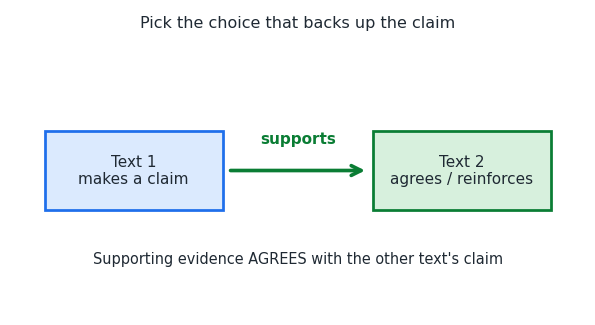
In a pair of texts, Text 2 usually does one of two things to the information in Text 1: it either supports it or contrasts with it. Supporting evidence pushes in the same direction as Text 1's claim, backing it up rather than challenging it. That support can take several forms, so it helps to see each one.
One way is to confirm Text 1 with fresh evidence. Text 1: A doctor suggests that a new exercise routine lowers blood pressure. Text 2: In a trial, patients who followed the routine for two months saw their blood pressure drop sharply. Text 2 supports Text 1 because the trial's results are new evidence that confirms the doctor's suggestion.
Another way is to give a specific example of Text 1's general point. Text 1: A critic claims that silent films relied on visual storytelling. Text 2: In one famous silent film, an actor conveys an entire tragedy through facial expressions alone, without a single spoken word. Text 2 supports Text 1 by offering a concrete case of exactly the visual storytelling the critic describes.
A third way is to explain why Text 1's observation is true. Text 1: A gardener notices that her roses bloomed far earlier than usual this spring. Text 2: This spring was unusually warm, and warmth is known to speed up flowering in roses. Text 2 supports Text 1 by supplying the reason behind the early blooming.
So the test is the direction. If Text 2 pushes the same way as Text 1 — confirming it, illustrating it, or explaining it — then it supports Text 1. If Text 2 pushes the opposite way, undercutting the claim, then it contrasts with it instead.
Worked examples
Text 1: A geologist claims that a certain U-shaped valley was carved long ago by a slow-moving glacier. Text 2: A recent survey of the valley floor found deep, parallel scratches gouged into the bedrock, exactly the marks a heavy glacier leaves as it grinds past. How does Text 2 relate to the information in Text 1? (A) It supports Text 1 by providing physical evidence of the glacier the geologist describes. (B) It contrasts with Text 1 by suggesting the valley was formed some other way. The glacier scratches are fresh evidence that confirms the geologist's claim. So (A) is correct: Text 2 supports Text 1.
Text 1: A teacher argues that students remember material better when they have to explain it to someone else. Text 2: In one class, the students who tutored a partner before the exam scored noticeably higher than the students who only reread their own notes. How does Text 2 relate to the information in Text 1? (A) It supports Text 1 by giving a real case where explaining led to stronger memory. (B) It contrasts with Text 1 by showing that explaining made no difference. Text 2 is a concrete example of the very effect the teacher claims. So (A) is correct: Text 2 supports Text 1.
Text 1: Researchers noticed that the fish in a certain lake became much healthier during one particular summer. Text 2: That same summer, a factory upstream stopped dumping its waste into the river, and the lake's water became far cleaner as a result. How does Text 2 relate to the information in Text 1? (A) It supports Text 1 by explaining what caused the fish to become healthier. (B) It contrasts with Text 1 by denying that the fish improved at all. Text 2 gives the reason behind the change that Text 1 observed. So (A) is correct: Text 2 supports Text 1.
Is this one of the topics costing you points?
Take the free 10-question diagnostic for a predicted SAT score and a breakdown of which domains are costing you points.