Identifying number of solutions of a system of equations
An SAT Math micro-topic under Linear and quadratic systems (Advanced Math). Free to read — no account needed.
The number of solutions to a system equals the number of places its graphs intersect. So to count solutions, count intersection points.
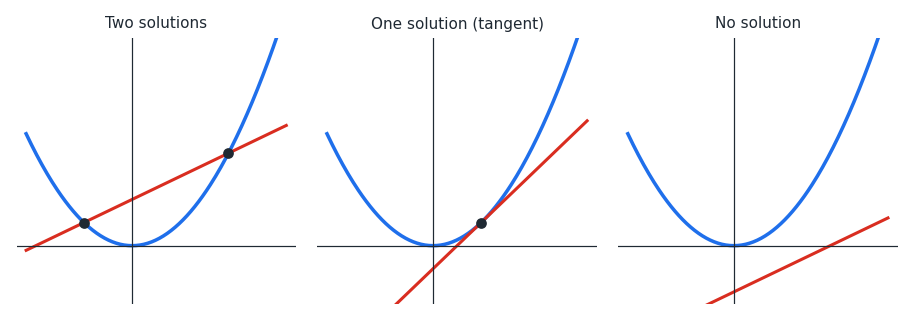
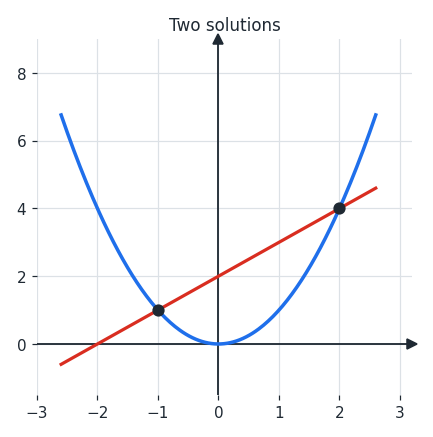
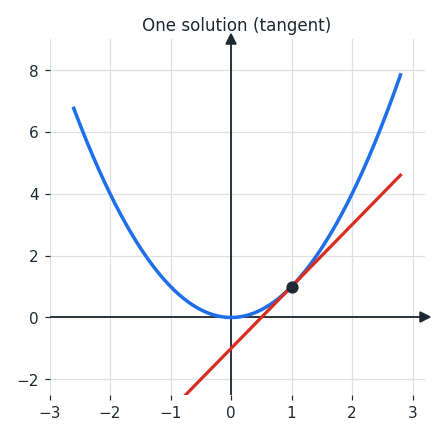
The figure shows the three cases for a line and a parabola. The line can cut through at two points (two solutions), just touch at one point where it is tangent (one solution), or miss entirely (no solution).
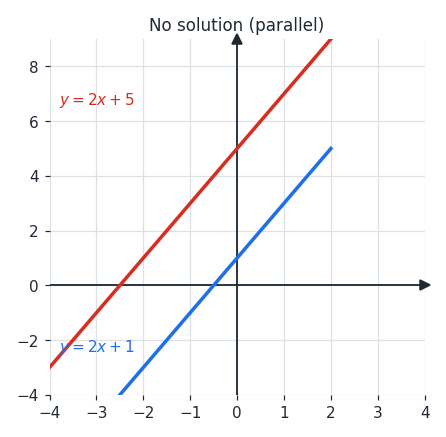
For two straight lines there are also three cases. Two lines that cross meet at one point (one solution). Two parallel lines with the same slope never meet (no solution), and two lines that are exactly the same overlap everywhere (infinitely many solutions).
You can see this from the algebra too. Setting a line equal to a parabola gives a quadratic, and its number of real roots — two, one, or none — is the number of solutions. For two lines, equal slopes with different intercepts give no solution.
Worked examples
At most, how many solutions can a system of a line and a parabola have? The line can cross the parabola in at most two points. So the system has at most two solutions.
A line is tangent to a parabola. How many solutions does the system have? A tangent line touches the parabola at exactly one point. So there is exactly one solution.
The lines y=2x+1 and y=2x+5 form a system. How many solutions does it have? Both lines have slope 2 but different y-intercepts, so they are parallel and never meet. So the system has no solution.
Is this one of the topics costing you points?
Take the free 10-question diagnostic for a predicted SAT score and a breakdown of which domains are costing you points.