An SAT Math micro-topic under Linear and quadratic systems (Advanced Math). Free to read — no account needed.
Solving a quadratic equation means finding every value of x that makes it true. The key idea is the zero-product rule: if two things multiply to 0, then at least one of them must be 0. So we rewrite the equation as (something)(something) =0, then solve each piece.
The most common method is factoring, and it follows a set recipe. For ax2+bx+c=0, first multiply a and c together. Then find two numbers that multiply to a⋅c and add to b. Use those numbers to split the middle term, group, and pull out the common factors. Take x2+5x+6=0, where a=1, b=5, c=6, so a⋅c=6. The pairs that multiply to 6 are 1 and 6, or 2 and 3; the pair that adds to b=5 is 2 and 3. So it factors as (x+2)(x+3)=0, giving x=−2 or x=−3.
When a quadratic will not factor nicely, use the quadratic formula:
x=2a−b±b2−4ac
Here a, b, and c are the numbers in ax2+bx+c=0. For x2−x−2=0, we have a=1, b=−1, c=−2. Plugging in gives x=21±3, so x=2 or x=−1.
If the equation is a perfect square set equal to a number, take the square root of both sides. For (2x+3)2=25, take the square root to get 2x+3=±5. That splits into 2x+3=5 and 2x+3=−5. Solving each gives x=1 or x=−4. Always keep the ±: a square root gives both a positive and a negative answer.
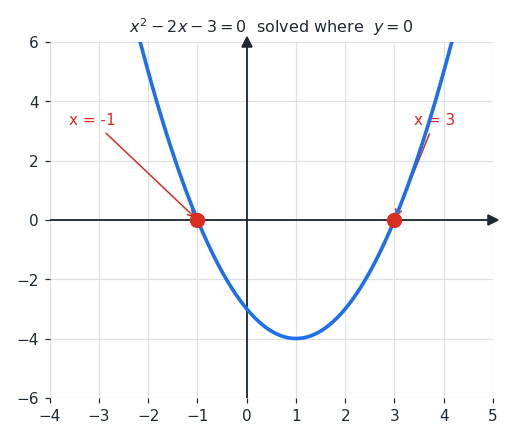
You can also find the solutions from a graph. Plot the parabola (a graphing tool like Desmos works well). Wherever it crosses the x-axis, that x-value is a solution. One caution: never divide both sides by x to solve, because x might be 0. Instead, move everything to one side and factor out x.
Worked examples
Solve x2+7x+12=0 by factoring. Here a=1, b=7, c=12, so a⋅c=12. Find two numbers that multiply to 12 and add to 7: those are 3 and 4. So (x+3)(x+4)=0, giving x=−3 or x=−4.
Solve 2q2−9q−5=0 by factoring. Here a=2, b=−9, c=−5, so a⋅c=−10. Find two numbers that multiply to −10 and add to −9: those are −10 and 1. Split the middle term: 2q2−10q+q−5=0. Group and factor: 2q(q−5)+1(q−5)=0, so (q−5)(2q+1)=0. This gives q=5 or q=−21.
Solve x2−4x−5=0 using the quadratic formula. Here a=1, b=−4, and c=−5. So x=24±16+20=24±6. This gives x=5 or x=−1.
Is this one of the topics costing you points?
Take the free 10-question diagnostic for a predicted SAT score and a breakdown of which domains are costing you points.