Impact of slope and intercepts in solutions to systems of inequalities
An SAT Math micro-topic under Graphs of linear systems and inequalities (Algebra). Free to read — no account needed.
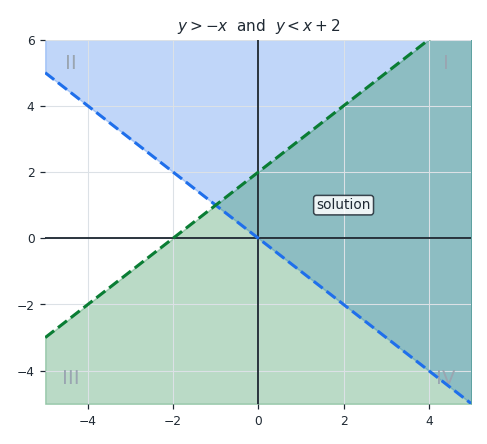
In a system of inequalities, the solution is where the two shaded regions overlap, because a point must satisfy both. To see where that overlap can live, it helps to first understand which quadrants a single shaded region covers. Let's build that intuition with one line, y=3x+2, and change it one small step at a time.
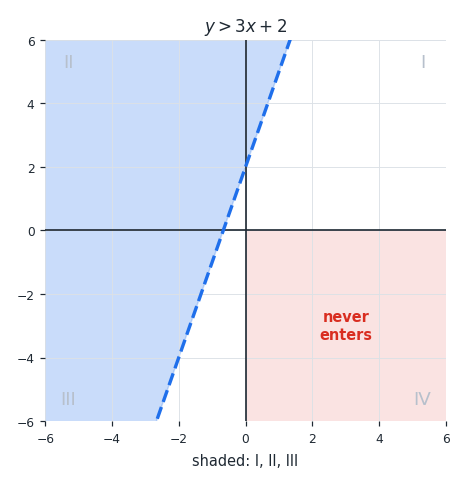
Start with y>3x+2, which means shade above the line. The shaded region fills Quadrants I, II, and III, but it never dips into Quadrant IV.
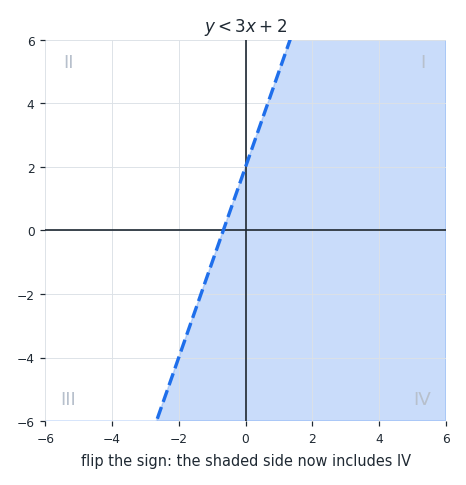
Now flip the sign to y<3x+2, which shades below the same line. The shading jumps to the other side, and this side does reach into Quadrant IV. So the direction of the inequality decides which side of the line you shade.
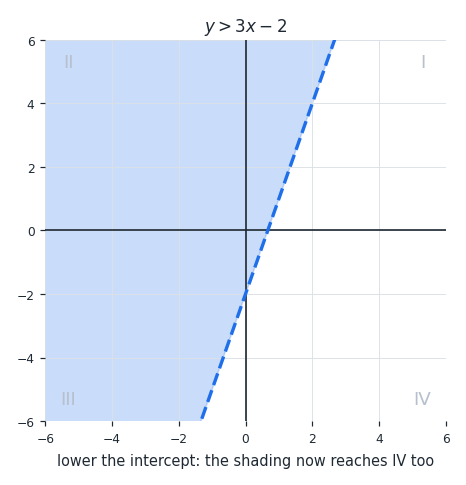
Go back to "greater than", but lower the intercept to y>3x−2. The line slides straight down by 4, so the region above it now spills into Quadrant IV as well. The intercept slides the whole line up or down.
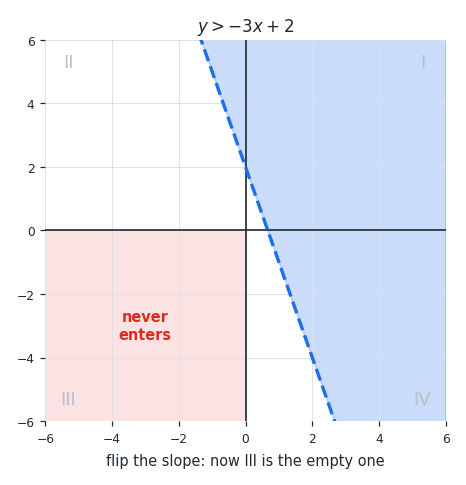
Finally, keep the intercept at +2 but flip the slope to y>−3x+2. The line tilts the other way, so the shading now fills Quadrants I, II, and IV, and this time it is Quadrant III that stays empty. The slope tilts the line and moves which quadrant is left out.
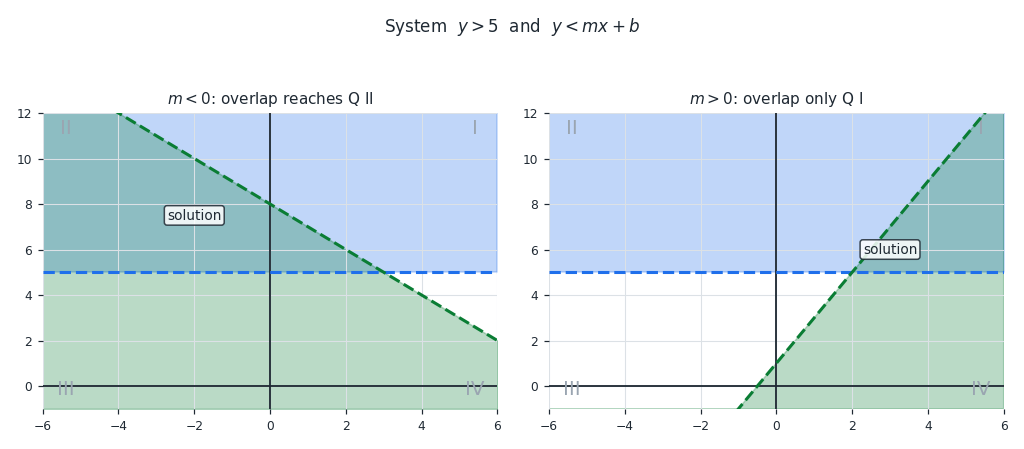
So two controls steer a shaded region: the intercept slides the line, and the slope tilts it. This is exactly what the system questions test. Take y>5 and y<mx+b: the flat line y=5 keeps the solution above 5, while the tilted line decides how far it reaches, so a positive slope keeps the overlap in Quadrant I and a negative slope lets it stretch into Quadrant II.
Worked examples
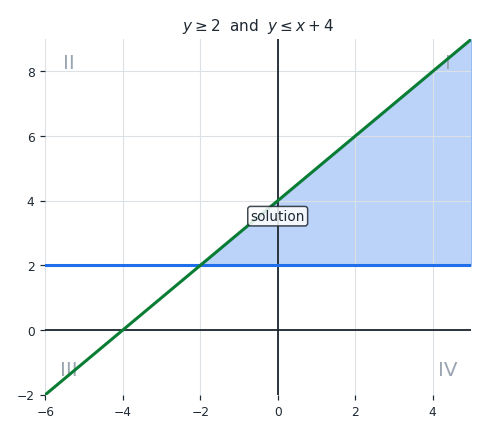
A system is y≥2 and y≤x+4. Where is its solution region? Shade at or above the line y=2, and at or below the line y=x+4. The solution is the band where these overlap, between the two lines.
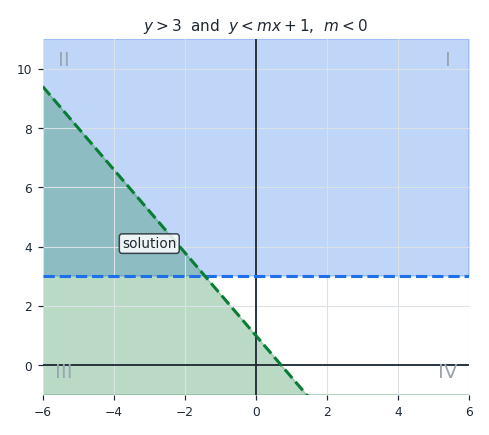
For the system y>3 and y<mx+1, which sign of m lets the solution reach Quadrant II? A negative slope makes y=mx+1 rise as x gets more negative. Then the strip above y=3 and below that line extends left of the y-axis. So m<0 lets the solution reach Quadrant II.
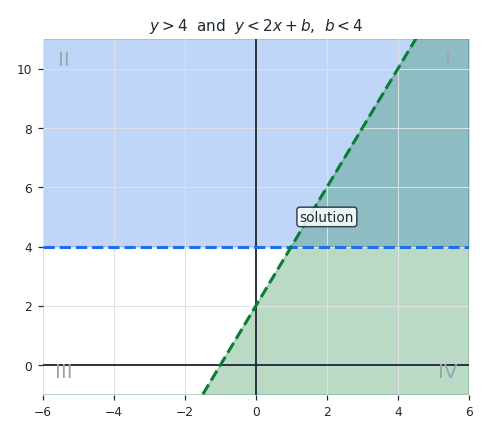
The system is y>4 and y<2x+b. For the solution to stay only in Quadrant I, what must be true about b? The line must cross y=4 at a positive x-value. Setting 2x+b=4 gives x=24−b, which is positive only when b<4. So the solution stays in Quadrant I when b<4.
Is this one of the topics costing you points?
Take the free 10-question diagnostic for a predicted SAT score and a breakdown of which domains are costing you points.